
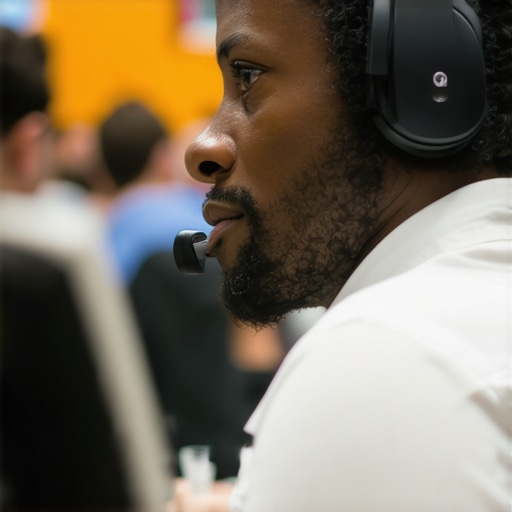
I remember one specific Tuesday morning last October. I had three deadlines looming, a caffeine headache starting to bloom, and a workspace that felt more like a busy train station than a professional environment. I was sitting at a communal table, and the woman next to me was having a very animated conversation about her startup’s pivot, while a group of three guys were loudly ‘collaborating’ over a laptop directly behind me. I tried to put my headphones on, but I could still feel the vibrations of the heavy foot traffic on the floorboards. I made a huge mistake that day: I tried to fight the noise with more noise, cranking up a heavy metal playlist until my ears rang. It didn’t help. I spent four hours ‘working’ but only managed to write about two hundred words of usable copy. It was a visceral failure that forced me to realize that simply showing up isn’t enough; you need a strategy to protect your brain when the walls are thin and the crowd is thick.
Stop Letting the Crowd Kill Your Productivity
We are all told that the beauty of shared spaces is the ‘serendipitous networking,’ but honestly, when you have a high-stakes project, that serendipity feels a lot like a distraction. It is easy to fall into the downside of hot-desking that nobody talks about, where you spend more time managing your environment than actually doing your job. Today, I want to show you exactly how I reclaimed my focus without having to pay for a private office every time the lounge gets busy. We’re going to talk about physical boundaries, the psychology of ‘visual noise,’ and why your current attempts at blocking out the world are likely backfiring. According to research from the University of California, Irvine, it takes an average of 23 minutes and 15 seconds to fully get back into the flow of a task after a single distraction—that is a terrifying statistic when you realize how often someone asks you where the extra oat milk is kept. Have you ever felt like you’re just treading water in a sea of noise at your hub? I’d love to hear your worst ‘distraction’ story in the comments below.
Is Focus Just an Illusion in an Open Plan?
I hear this all the time from skeptics: ‘If you want quiet, just stay at home.’ But for many of us, the home office is even worse, or we crave the energy of a startup ecosystem even if it’s currently too loud. The fear is that by choosing a social environment, we’ve permanently traded away our ability to do deep work. I’m here to tell you that’s not true. You don’t have to be a victim of the floor plan. I’ve learned that finding a quiet corner in the busiest coworking hubs is actually an art form that involves timing, gear, and a bit of social engineering. Early in my career, I thought I was being ‘flexible’ by sitting wherever there was an open chair, but that was my second biggest mistake. Now, I treat my desk selection like a tactical mission. If you’re struggling with the etiquette of using a common area for a focus sprint, you aren’t alone, and you aren’t ‘difficult’ for needing silence. It’s about setting expectations with those around you so you can actually deliver the work that pays for that membership in the first place.
Tactical Methods to Reclaim Your Mental Real Estate
The biggest mistake most of us make is thinking we can ‘power through’ a chaotic environment. Think of your attention span like a battery; every time you look up to see who just walked in, you lose 5% of that charge. To stop the bleed, you have to treat your desk like a high-security server room. You wouldn’t leave a server open to the public internet without a firewall, so why do you leave your focus open to every passerby? Reclaiming your mental real estate starts with physical boundaries.
Build a Physical Moat Around Your Desk
Visual noise is often more damaging than actual sound. If your eyes catch movement, your brain shifts gears. I once experimented with placing my laptop on a high stand and using my backpack as a literal wall on the left side of my desk to block out the view of the coffee machine. It felt slightly paranoid, but my output doubled because I wasn’t constantly being ‘pinged’ by the sight of people frothing milk. This is a core part of how to handle the noise problem in open plan offices—it’s not just about what you hear, but what you see. Use plants, monitor heights, or even a strategically placed jacket to narrow your field of vision to just your work.
Signal Your Availability Without Saying a Word
In a shared space, a friendly face is an invitation for a chat. If you want to get work done, you have to learn the art of the ‘soft no.’ This is where high-quality gear becomes your best friend. I started using a pair of massive, bright red noise-canceling headphones. It wasn’t just about the music; it was a beacon that said ‘I am currently unavailable.’ Before I did this, I was constantly caught in small talk that derailed my morning. Understanding the etiquette of taking a private call in an open lounge or doing deep work starts with these visual cues. You are training the people around you to respect your ‘focus sprints’ by providing a clear, non-verbal signal that you’re in deep-work mode.
Snag a Meeting Room for Your Toughest Tasks
Sometimes the open floor is a lost cause, and that’s okay. When I have a deadline that requires 100% of my brainpower, I stop trying to make the lounge work and I book a room. There is a specific kind of magic in the acoustic secrets of high-end conference rooms that can’t be replicated with headphones alone. Last month, I had to finalize a series of investor pitches. After two hours of struggling in the common area, I moved to a small, glass-walled pod for an hour. The total silence allowed me to enter a flow state that felt like a superpower. If you learn how to maximize productivity in your startups conference rooms, you stop seeing them as just ‘meeting places’ and start seeing them as focus sanctuaries. It’s about being tactical with your membership credits to buy the quiet you need.
Master the Art of the Pre-Flight Checklist
Before you even sit down, you need to have everything you need. Every time you have to get up to find a charger, a pen, or a refill of water, you are inviting a distraction. I once lost forty minutes because I forgot my dongle and had to wander through three different floors asking people if they had a spare. Now, I have a dedicated ‘coworking kit’ that never leaves my bag. This is how you avoid the friction of a disorganized day and learn how to get the most value out of your coworking membership. By being self-contained, you reduce the surface area for interruptions and keep your focus locked on the task at hand.
The conference room is the most misunderstood asset in the startup world. Everyone tells you they are exclusively for ‘syncs’ and ‘brainstorming sessions,’ but in my experience, using a meeting room for a group chat is often the least efficient way to spend your credits. We’ve been conditioned to think that shared spaces are for the hustle and glass rooms are for the crowd. I’m here to tell you that’s a myth that is likely stalling your progress. If you want to achieve true elite-level focus, you need to treat these rooms as high-intensity isolation chambers rather than just places to show off a slide deck. When you look at startup success secrets choosing the perfect conference room, the real winners aren’t those with the most meetings, but those who know when to lock themselves away to crush a complex problem.
Can visual privacy actually double your output?
One of the biggest mistakes I see founders make is ignoring the ‘spectator effect.’ Even if your headphones are at max volume, your brain is subconsciously processing the movement of people walking past the glass. A study published in the Journal of Environmental Psychology indicates that ‘visual noise’ in open or transparent environments can decrease cognitive performance by up to 15% because our brains are hardwired to monitor for social cues. This is why I always look for rooms with frosting on the glass or corners that face away from the main thoroughfare. Knowing how to choose the perfect conference room for business success isn’t just about the number of chairs; it’s about the quality of the ‘visual silence’ it provides. I’ve found that even an hour in a truly private space yields more than three hours in the ‘energy’ of the lounge.
Avoid the ‘Smart Room’ Tech Trap
There is a specific kind of professional nightmare: you have a high-stakes investor on Zoom, and you spend the first ten minutes wrestling with a proprietary tablet system that refuses to recognize your laptop. I call this the ‘Oops Factor.’ Many people assume that the more expensive the room, the better the experience, but the problem with tech-heavy meeting rooms that nobody knows how to use is a genuine productivity killer. Before you book that ‘Ultra-Smart Suite,’ ask yourself if you actually need the 80-inch touchscreen. Usually, a simple room with reliable Wi-Fi and a plain whiteboard is far superior because there are fewer points of failure. I once lost a potential client because the ‘automated’ blinds in a high-end hub got stuck halfway, making my screen unreadable. Simplicity is a feature, not a bug.
Ditch the Long Tables for Better Results
If you actually are having a meeting, stop sitting at the ends of long, rectangular tables. It creates a hierarchy that kills the creative flow of a small team. I’ve become obsessed with the hidden psychology of circular meeting tables. They force eye contact and equal participation in a way that ‘boardroom’ layouts never can. It’s a subtle nuance, but it’s the difference between a lecture and a collaboration. If you’re struggling to get your team to speak up, change the furniture, not the agenda. Have you ever fallen into the trap of booking a room that was ‘too smart’ for its own good? Let me know in the comments below. We’ve all been there, and learning how to maximize productivity in your startups conference rooms often starts with realizing that the most expensive room isn’t always the most effective one.
It took me three years of jumping between hubs to realize that the ‘perfect’ space doesn’t exist; you have to build it yourself every morning. Once you’ve mastered the art of grabbing the right chair, the next challenge is keeping that momentum as your startup grows from a solo mission into a full-fledged team. Scaling introduces a whole new layer of chaos that your noise-canceling headphones can’t solve on their own. I’ve seen too many founders burn out because they tried to run a ten-person company with a one-person mindset. To avoid this, you need a tech stack that works regardless of whether you are in a glass-walled pod or a suburban lounge.
Equip Your Bag Like a Pro to Avoid Daily Friction
If you are serious about your output, you need to stop relying on whatever tech the hub provides. I’ve started carrying a ‘power-user kit’ that includes a portable 15-inch USB-C monitor and a dedicated mobile hotspot. Why the hotspot? Because even the best hubs have bad days, and knowing the checklist for a glitch-free hybrid board meeting starts with having a redundant internet connection. I also swear by Krisp.ai; it’s an AI-powered noise-suppression tool that filters out the sound of a nearby espresso machine during my Zoom calls. It’s these small technical investments that allow me to maintain a professional presence even when the environment is far from it. Beyond the hardware, you must think about security. When you are constantly switching networks, why endpoint protection services matter more when your team is hybrid becomes a daily reality, not just a line item in your IT budget. Don’t be the person who gets their credentials skimmed because they were too lazy to use a VPN in the lounge.
How can you keep your focus strategy alive for the long haul?
Maintenance is where most people fail. They have one productive week and then slip back into old habits of ‘just winging it.’ I keep my focus alive by doing a weekly ‘space audit.’ Every Friday afternoon, I review which locations and rooms gave me the best ROI. If a specific corner was too loud on Tuesday, I mark it on my digital map to avoid it next week. This data-driven approach is essential when you begin to think about how to scale your office space without breaking the lease. You need to know exactly how much private time your team actually requires versus how much they spend in the common areas. According to technical documentation from Cisco regarding modern workspaces, a human-centric office requires a balance of ‘active’ and ‘quiet’ zones to prevent cognitive fatigue—simply adding more desks to a room is a recipe for a productivity crash.
The Coming Shift Toward Predictive Space Management
I predict that in the next eighteen months, we are going to see a massive shift toward AI-managed environments. We won’t just book a room; an algorithm will look at our calendars and suggest a specific suite based on our past focus levels and the real-time noise decibels of the building. This is the heart of the future of conference rooms in startup ecosystems. We are moving away from static offices and toward dynamic, responsive environments that adapt to our biological needs for silence and light. If you want to stay ahead of the curve, I highly recommend you start using a time-tracking app like Toggl paired with a location tag. You’ll be shocked to see how much your physical surroundings correlate with your hourly billables. My challenge to you: for the next five workdays, track exactly where you sit and rate your focus on a scale of 1 to 10. The results will give you the ‘map’ you need to dominate your next high-stakes project.
Hard-Won Secrets from a Coworking Veteran
Most people treat their membership like a gym pass—they show up and expect results by osmosis. I learned the hard way that the truth about community managers in coworking spaces is that they provide the stage, but you have to provide the performance. You aren’t just renting a desk; you are managing a psychological environment. I’ve realized that my best days happen when I stop trying to be ‘polite’ with my time and start being protective of it.
Don’t be afraid to be the person who doesn’t look up; in a busy hub, your focus is your most valuable currency. It took me years to realize that the person ‘bothering’ me was often just looking for the same social validation I was—setting a firm boundary with noise-canceling gear actually helps everyone understand the local culture of deep work better.
What I Pack to Stay Productive Anywhere
Beyond my noise-canceling setup, I rely on a few non-negotiables to keep the momentum going. I use Toggl to track my efficiency in different zones—this data helped me realize that finding a meeting room that actually has natural light boosted my afternoon output by 20% compared to windowless pods. I also suggest checking if your coworking membership is a tax deductible expense, as those annual savings often pay for the high-end hardware that makes remote work viable. A dedicated mobile hotspot and a portable monitor are my two biggest force multipliers.
#IMAGE_PLACEHOLDER_E#
Take Back Your Calendar Today
Productivity in a busy startup environment isn’t about escaping the noise; it’s about outsmarting it. Whether you are booking a conference room for a solo sprint or finding a new way to signal your focus in a coworking lounge, the control is in your hands. You don’t need a quiet office to do great work; you just need a better strategy for the meeting rooms and shared spaces you already have access to. The future of conference rooms in startup ecosystems is flexible, and your workflow should be too. Start small: change your seat, put on your headphones, and watch your output transform. What’s the one thing that always breaks your focus in a shared office? Share your biggest distraction in the comments below!