
I spent six months trying to build a fintech prototype in my basement, convinced that talent is global meant I should only hire through LinkedIn. I eventually found a technical partner from three time zones away. We lasted three weeks. The breakdown didn’t happen because of code quality; it happened because we didn’t know how to argue. I realized then that finding a co-founder isn’t about scanning a PDF—it’s about seeing how someone handles a glitchy projector in a cramped room or how they treat a barista during a morning rush.
Why Your Couch is the Worst Place to Vet a Partner
Finding a co-founder is a lot like dating, except the stakes involve your life savings and your sanity. My biggest mistake early on was thinking I could optimize the search by staying behind a screen. I would send cold DMs, hop on awkward Zoom calls, and pretend I could feel a vibe through a grainy webcam. It was a disaster.
Can you really find a million-dollar partner at a casual mixer?
You might think these local events are just for people looking for free pizza, but that is where the magic happens. When you are standing in one of the top conference rooms in the city watching a developer struggle with a live demo, you see their real character. Do they sweat and panic, or do they crack a joke and pivot? That is information a resume will never give you. Research from CB Insights shows that team problems are the third most common reason startups fail, accounting for 23% of all collapses. Meeting in person isn’t just nice; it is a survival tactic.
Get Out of the House and Into the Room
Local events provide a low-pressure environment to test-drive a professional relationship before you sign any paperwork. You quickly learn the secret to making a great first impression on a potential partner isn’t about your pitch deck—it’s about your presence and how you handle the room. This is why your startup needs a physical presence in the city. You need to be where the friction and the ideas are happening in real-time. Have you ever felt that sinking feeling when a perfect online hire turned out to be a total personality mismatch once you finally met for coffee? I have been there, and I don’t want you to repeat that expensive mistake. Today, I am going to show you how to turn a simple local meetup into your most powerful recruiting tool.To move from a solo founder to a team, you have to stop thinking like a recruiter and start thinking like a scout. The goal isn’t to find the best resume; it’s to find the person who complements your chaos with their competence. You need to identify the environments where these people already exist, which usually means stepping into the trenches of the local tech scene.
Filter Your Future Team by Showing Up Where They Work
Your first step is to stop attending general networking mixers where everyone is just swapping business cards and start attending functional workshops. Look for technical sessions, hackathons, or deep-dive product seminars. You want to see how a potential partner thinks when they are actually building something. This is the best way to unlock networking opportunities in top coworking environments without the artificial fluff of a happy hour. Before you commit to any one place, you should learn how to spot a bad coworking community before joining, because the wrong environment will attract the wrong talent.
Look for the Fixers at Local Workshops
When I was hunting for my current CTO, I attended a local server-side optimization workshop. I wasn’t there to learn the code; I was there to see who was asking the smartest questions. I found a developer who didn’t just solve the exercise but helped three other people at his table. That altruism in a high-pressure technical setting is a massive green flag. If you are planning something similar, knowing how to host a workshop that people actually enjoy can position you as the leader they want to follow.
Treat Your First Meeting Like a Stress Test
Once you have a prospect, don’t go back to Zoom. Book a neutral space and run a four-hour ‘Day Zero’ sprint. I remember one specific Saturday when I rented a small glass-walled room with a candidate to map out our database schema. Two hours in, the building’s Wi-Fi flickered out. It was a moment of truth. Instead of complaining, he immediately pulled out a backup hotspot and said, ‘This happens, let’s keep going.’ That told me more about his resilience than any portfolio ever could. Understanding startup success secrets for choosing the perfect conference room means picking a place where you can actually work, not just sit and talk.
Watch How They Navigate Shared Etiquette
A coworking space is a microcosm of a company culture. Pay attention to how your potential partner interacts with the community manager or how they handle the truth about shared office noise levels. If they get irrationally angry at a loud coffee machine or a chatty neighbor, they probably won’t handle the pivots of a startup very well. This is why we prefer hourly rentals for client meetings and partner vetting; it gives you a controlled environment to witness their ‘real-world’ personality without the commitment of a long-term lease.
Use Professional Spaces to Signal Serious Intent
If you ask a high-level developer to meet you at a noisy fast-food joint, you are signaling that your idea isn’t worth their time. However, when you invite them to a professional hub, it changes the dynamic. It shows you have skin in the game. You don’t need a massive headquarters yet; even a well-equipped meeting room can bridge the gap. It provides the privacy needed for honest conversations about equity and roles while surrounding you with the energy of other growing companies. This professional backdrop is often what tips the scale for a talented person to leave their stable job and join your ‘crazy’ idea.
The shiny amenities trap that distracts from real work
Most founders believe that the more perks a coworking space offers—think craft beer on tap and arcade machines—the more innovative their team will be. In reality, I have found that why the all-inclusive membership is usually a trap is because you are often subsidizing square footage for social fluff rather than technical utility. When you are vetting a partner, you do not need a lounge; you need a place where the Wi-Fi won’t drop during a git push. I have seen countless startups waste their seed money on “vibes” only to realize they are stuck in a space where no one actually talks to each other. This is how to tell if a coworking space is just a glorified library: if everyone has their noise-canceling headphones on and the community manager is nowhere to be found, your networking potential is zero.
Does a pool table actually help you build a better product?
Probably not. In fact, research published in the Harvard Business Review indicates that the “social physics” of a workspace—how people actually move and interact—is a far better predictor of productivity than fancy furniture. If your potential co-founder is more interested in the snacks than how to maximize productivity in your startups conference rooms, that is a subtle but vital data point. I once passed on a brilliant backend dev because he spent our entire “Day Zero” sprint complaining that the espresso machine was broken. It showed me that his focus was on comfort, not on the mission. Have you ever fallen into this trap? Let me know in the comments.
Why small satellite offices are quietly beating the mega-headquarters
We often think that bigger is better, but why small satellite offices are beating the mega-headquarters comes down to the quality of the “bump factor.” In a massive hub, you are just a number. In a smaller, focused environment, you are a peer. This intimacy allows you to how to manage office politics when you share a floor with other startups more effectively because you actually know your neighbors. 
Don’t sign your life away for a cool address
One of the most dangerous moves I see is the ego-driven lease. You get a little funding, and suddenly you want your name on a building. Please, why you shouldnt sign a lease for your first 10 employees is simple: your team will change faster than your contract. Use flexible memberships to how to choose an office that supports your scaling speed instead. It allows you to pivot your physical space as quickly as you pivot your product. If you find a partner who insists on a “real” office before you have a real customer, run the other way. They are in love with the idea of being a founder, not the work of being one.
Don’t Let Your New Partnership Flame Out
Once you have found that perfect partner, the real work begins. I have seen more founders lose their spark in the first ninety days than in the first three years, simply because they didn’t have a system to keep the communication high-fidelity. You need to transition from the ‘vetting phase’ into a sustainable rhythm. This means intentionally maximizing productivity in your startup’s conference rooms by setting a weekly cadence that isn’t just about status updates, but about solving the friction points you identified during your ‘Day Zero’ sprint. I personally use a ‘red-yellow-green’ system every Friday afternoon. We meet in a neutral space, away from our desks, and list exactly what felt like a drag (red), what’s okay but needs polish (yellow), and what is humming (green). It keeps the air clear and prevents resentment from festering in the corners of a shared office.
The Tech Stack That Actually Keeps Us Sane
Stop relying on your laptop’s built-in microphone for hybrid calls. If you are in a shared space, the echo is your enemy. I never go into a meeting room without my Jabra Speak 710. It’s a portable puck that turns any table into a professional-grade audio hub. Why? Because 360-degree omnidirectional mics ensure your remote team members don’t feel like second-class citizens. When you are choosing the perfect conference room for business success, audio clarity is the one variable that can make or break an investor pitch or a developer sync. 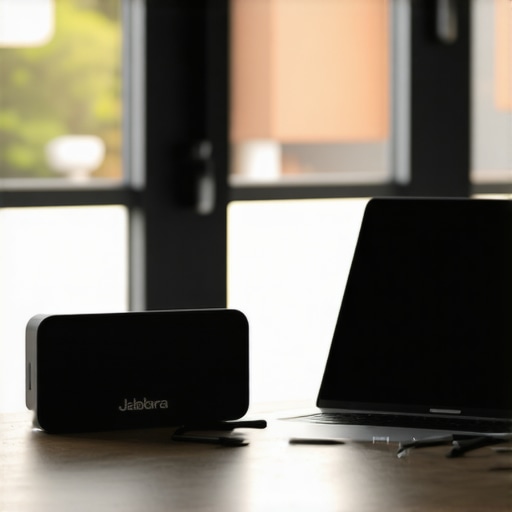
How do I maintain this creative momentum over time?
Consistency is more important than intensity. You maintain it by rotating your environment before you get bored. I found that why your team is more productive with a change of scenery isn’t just a cliché—it’s biological. We switch our ‘deep work’ days between different hubs to keep our brains from going into autopilot. If you find yourself hitting a wall, it’s probably time to learn how to handle the noise problem in open plan offices by moving to a dedicated quiet zone for a few hours. These micro-adjustments prevent the ‘tech prison’ feel that many startups fall into after six months in the same four walls.
Why Your Network Security Is Probably Leaking
Security is the most overlooked part of the ‘working from anywhere’ lifestyle. According to the National Institute of Standards and Technology (NIST) Special Publication 800-114, securing external devices in a shared environment is the absolute first line of defense for any remote-first team. This is why endpoint protection services matter more when your team is hybrid. I have seen founders lose months of work because they used a public Wi-Fi without a hardware-level VPN. I recommend using a dedicated travel router like the GL.iNet Beryl; it creates a private encrypted bubble for all your team’s devices, regardless of where you are sitting. Looking ahead, I predict the future of conference rooms in startup ecosystems will involve integrated AI that automatically encrypts and scrubs all local data caches the moment your session ends. Try this: The next time you host a high-stakes meeting, don’t just rely on the venue’s Wi-Fi password. Bring your own hardware firewall and watch how much more confident you feel when discussing sensitive equity structures. It is a small investment that signals to your partner—and your investors—that you are a pro.
Lessons I Learned the Hard Way While Hunting for a Tech Partner
After six months of trial and error, the most valuable lesson I can share is that your partner’s reaction to a minor crisis is a preview of your startup’s future. I once watched a potential hire completely freeze up during a Wi-Fi dropout; that five-minute window told me more than his decade of experience at a FAANG company ever could. You need to see how a person reacts to pressure, which is exactly why I recommend you learn how to handle a server crash from a temporary desk before you sign any legal documents. Another lightbulb moment was realizing that professional optics matter for internal trust too. It is much easier to convince a high-level developer to take a risk on you when you aren’t meeting in your living room. When you see why investors prefer meeting in professional spaces, you realize the same logic applies to top-tier talent.
Tools and Resources That Keep My Partnership From Redlining
Building a team is much easier when you have a reliable infrastructure to support your collaboration. Beyond the physical space, I always carry a few essentials to ensure my ‘Day Zero’ sprints go smoothly. I trust the Jabra Speak 710 for every hybrid meeting because audio lag kills creative momentum. For security, the GL.iNet Beryl travel router is non-negotiable for protecting our code in shared environments. When it comes to selecting your environment, I rely on the data found in how to choose the perfect conference room for business success to ensure we have the privacy and speed we need. Finally, stop overthinking the long-term and look at the logic of choosing a flex office over a 5-year lease so you can stay lean while you scale.
Take Your Idea Out for a Real World Test Drive Today
The transition from a solo founder to a thriving team doesn’t happen behind a keyboard. It happens in the shared lounges, the late-night hackathons, and the focused atmosphere of a professional hub. By putting yourself in a high-density environment, you increase the surface area for ‘lucky’ encounters that lead to million-dollar partnerships. It’s time to stop searching for a resume and start looking for a teammate. Your future co-founder is likely already out there, probably frustrated with their own home office distractions or seeking a better workspace just like you were. Go find them. #IMAGE_PLACE_HOLDER_E#
Have you ever felt that a potential business partner was a perfect match online but a total disaster once you met in person? Let me know your story in the comments below!