
I remember sitting in a windowless conference room three years ago, watching twelve people stare blankly at a slide deck I’d spent all night perfecting. The air was thick with boredom. I could literally hear the clock ticking. I realized then that I wasn’t teaching; I was hostage-taking. It was a visceral failure. That was the moment I swore I’d never host another “mandatory fun” session again. Today, I want to show you how to flip the script. We aren’t just talking about scheduling a meeting; we’re talking about crafting an experience that builds your startup’s culture and actually moves the needle on your projects. My early mistake was thinking the content was all that mattered. I ignored the vibe, the comfort, and the location. In fact, the nightmare of trying to host a workshop at a coffee shop taught me that if you don’t control the environment, the environment will control you.
Stop Boring Your Team to Tears
The “Why” matters more than the “How” right now. Most workshops fail because they feel like an extension of the workday rather than a break from it. You need a space that inspires. If your team is stuck in the same four walls they see every Monday morning, their brains stay in “Monday morning” mode. This is why your meeting room layout is killing participation without you even realizing it. Have you ever looked around a room mid-presentation and realized everyone was just waiting for the catering to arrive?
Will people just think this is another waste of time?
It’s a valid fear. Most of us have “meeting fatigue.” But a well-run workshop is the antidote. It’s the difference between a dull status update and a productive brainstorming session away from the office. According to a study often cited in the Harvard Business Review, physical environment can influence creative performance significantly, yet most founders treat it as an afterthought. If the chairs are uncomfortable or the lighting is dim, you’ve lost the battle before you’ve even handed out the sticky notes.
Get Out of Your Own Office for a Change
To get different results, you need a different setting. Stepping into a fresh space sends a signal to the brain that it’s time to think differently. This is why your startup needs a better first impression than a cluttered back room. When you host a workshop in a dedicated professional space, you eliminate the distractions of the daily grind. No one is going to pop their head in to ask about a missing invoice. You create a container for focus. I’ve found that even the simple act of finding a meeting room with decent natural light can keep energy levels from cratering at 2:00 PM. We are going to look at the practical steps to make this happen, but first, you have to commit to leaving the stale routine behind.
Run a Tech Audit Before the Team Arrives
You wouldn’t host a dinner party without checking if the oven works, yet founders do the equivalent with HDMI cables every single day. I once spent forty minutes of a two-hour strategy session sweating under a table because I didn’t know how to vet a conference room for client-facing speed. The solution is the 15-minute early rule. Arrive before everyone else to how to test the wi-fi speed before you book that venue. If the connection is spotty, your workshop is dead on arrival. I learned this the hard way when a crucial product demo lagged so badly that the investor literally started checking his watch. Knowing what to do when the office wi-fi goes down mid-pitch eventually saved my skin in later meetings, but the embarrassment of that first failure stuck. Treat the tech like your most temperamental employee; give it attention before it demands it. If the room has a legacy AV system that looks like it belongs in a museum, move on. You need a space that supports modern tools without requiring a PhD in electrical engineering. 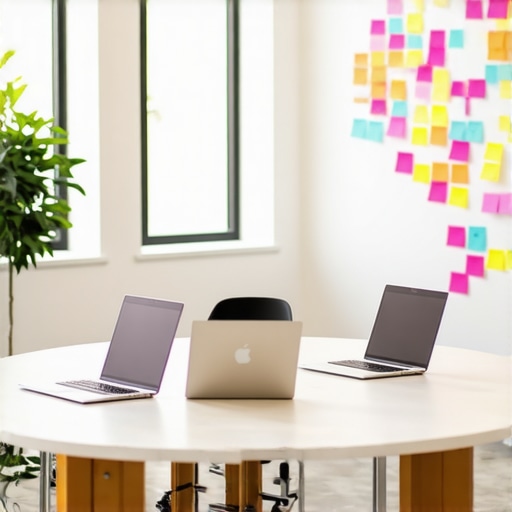
Tables Are More Than Wood and Metal
Most people think a table is just a place to put a laptop. It is actually a psychological boundary. If you want a collaborative vibe, ditch the long rectangle where you sit at the head like a medieval king. Dive into the hidden psychology of circular meeting tables. A circle removes the boss seat and invites everyone into the conversation. I switched to a circular setup for our monthly sprints, and participation jumped by thirty percent overnight. It was a simple shift, but it changed the power dynamic of the room instantly. When people feel equal to their peers, they stop filtering their ideas and start contributing. If you are stuck with a standard boardroom setup, try having everyone sit on the same side or use the walls for sticky notes to force movement. You want to break the physical stagnation that often leads to mental stagnation.
Beat the Infamous Afternoon Slump
Around 2:30 PM, the carb coma hits. If you haven’t planned for this, your workshop will end in a chorus of yawns and heavy eyelids. This is exactly when you need to know how to maximize productivity in your startups conference rooms by 0245-pm. It is not just about high-quality caffeine; it is about air quality, lighting, and movement. I make it a strict rule to stand up every forty-five minutes. We move to a different part of the coworking space or even step out to a lounge for a quick transition. It breaks the monotony and resets the brain’s focus timer. I recall one particularly grueling session where the energy was so low I could feel the collective IQ of the room dropping. I forced everyone to stand up and walk to the local cafe for five minutes. We came back with twice the energy. This is why your teams productivity drops after two pm and why you need to be proactive. A simple change of scenery, even just moving to a different corner of the room, can be the difference between a breakthrough and a total washout. Ensure you have finding a meeting room with decent natural light as a priority during booking, as artificial yellow light is a known productivity killer for developers and creatives alike.Let’s dig deeper into the architectural myths that are holding your team back. We’ve been sold a lie for a decade: that ‘total transparency’—those floor-to-ceiling glass walls—somehow fosters collaboration. In reality, it often does the opposite.
Ditch the Fishbowl to Save Your Teams Focus
When your team is in a meeting and every passerby can peek in, they perform for the audience rather than solving the problem. This is why your startup needs a real door not just a glass wall. I’ve seen brilliant developers shut down their most creative ideas simply because they felt ‘observed’ by the sales team walking past. If you’re serious about high-stakes work, you need to know how to keep your startups trade secrets in an open office. It’s not just about NDAs; it’s about physical barriers that allow for raw, unpolished vulnerability.
Stop Paying for Pool Tables and Beer Taps
The biggest ‘oops’ factor I see with founders is choosing a space based on the ‘cool’ factor. They see a neon sign and a pool table and think it’ll automatically attract talent. But does your office actually need a pool table if the meeting rooms have the acoustic quality of a tin can? I’ve watched startups burn thousands in seed funding on ‘lifestyle’ perks while their teams struggle with the acoustic fix for echoey conference rooms. In my experience, why founders are prioritizing location over fancy amenities is the real indicator of long-term success. You want a space that supports the work, not a playground that distracts from it. Furthermore, why the open plan office is failing your developers often comes down to the constant noise of these ‘fun’ zones leaking into deep-work areas.
How do you keep secrets in a room full of strangers?
This is the advanced level of coworking. If you’re pitching a VC or discussing a sensitive pivot, you can’t have ‘thin wall’ syndrome. A study published in the Journal of Environmental Psychology confirmed that acoustic privacy is the single most important factor for workplace satisfaction, yet it’s the first thing sacrificed in ‘modern’ designs. This is why the logic of choosing a flex office over a 5-year lease makes so much sense; you can move the moment the ‘vibe’ turns into a distraction. When you’re hunting for your next spot, look for the ‘bones’ of the building—thick walls and professional-grade insulation. Have you ever fallen into the trap of booking a space that looked great on Instagram but was a disaster for actual work? Let me know in the comments. Investing in the true roi of a premium coworking membership isn’t about the artisan coffee; it’s about the silence and the security that allows your team to reach deep flow. Finally, knowing how to keep your focus when the coworking hub is packed is a survival skill for the modern founder who refuses to settle for a mediocre environment.If the room looks like a million bucks but sounds like a wind tunnel, you have already lost. I’ve realized over the years that the most expensive mistake you can make is ignoring audio quality in a hybrid world. We’ve all been in that meeting where one person sounds like they are calling from inside a garbage disposal. It kills flow instantly. I personally carry a high-end portable speakerphone because I can’t always trust the built-in tech. This is one of the biggest factors in how to stop your team from hating hybrid meetings. When everyone can hear the nuances of a joke or the slight hesitation in a developer’s voice, the meeting becomes human again. Beyond that, I swear by high-quality peripherals; the truth about noise-canceling headphones in shared spaces is that they aren’t just for you—they are a courtesy to the people on the other end of the line.
Treat Your Microphones Like Your Life Depends On Them
Bad audio is physically draining. According to the Shure White Paper on Speech Intelligibility, maintaining a noise floor below 35-40 dBA is critical for reducing ‘listener fatigue’ during remote collaboration. If your meeting room has too much echo, the brain has to work harder to decode the words, leaving less energy for actual problem-solving. This is why I obsess over the ‘bones’ of a space before I sign a membership. You need to ensure the room isn’t just a glass box designed for photos but a functional tool for communication.
How do I maintain this creative momentum over time?
Consistency is the silent killer of startup energy. You have to actively fight the drift toward ‘corporate beige’ thinking. One way I do this is by rotating our meeting locations to prevent the space from feeling like a chore. Finding a workspace that doesnt feel like a tech prison requires a commitment to aesthetics that actually reflect your team’s personality. If you stay in one spot too long, the walls start to close in. I’ve found that the role of community managers in the modern workspace is vital here; they are your allies in keeping the environment fresh, whether that’s by helping you move furniture or suggesting a better-lit corner of the hub.
Stop Letting Your Tech Turn Into a Prison
As you scale, you will be tempted to build your own massive office, but I’ve seen that kill more startups than it saves. The overhead becomes a distraction. Focus on how to choose an office that supports your scaling speed rather than one that anchors you to a five-year mistake. This keeps your team agile. I’ve noticed that why your hybrid team feels disconnected on mondays is often because the transition from home to a sterile office is too jarring. You need a space that feels like a destination, not a duty. Looking ahead, the future of conference rooms in startup ecosystems is moving toward fully adaptive AI-driven environments that adjust lighting and acoustics based on the number of people in the room. We aren’t there yet, but you can start by being the person who brings a little more intention to every booking. Try one specific advanced tip: next time you book a room, bring a dedicated condenser microphone instead of relying on the laptop mic—the difference in team engagement will shock you.
Lessons I Paid for with Missed Deadlines and Dead Silence
One thing I’ve learned the hard way is that the atmosphere of the room starts before the first person walks in. I always do a ‘sniff test’—if the room smells like stale cleaning supplies or old carpet, I open a window immediately. It sounds trivial, but the true roi of a premium coworking membership is often found in these small sensory details that keep people comfortable. Another lightbulb moment was realizing that the best ideas don’t happen while sitting; they happen while moving. If you’re not finding a meeting room with decent natural light, you’re basically asking your team to work in a cave. Finally, always have a ‘Plan B’ for your visuals. If the screen fails, you need a physical whiteboard and a fresh set of markers. My biggest failure happened when I didn’t have a backup, and we spent two hours staring at a blank wall.
#IMAGE_PLACEHOLDER_E#
The Founder’s Survival Toolkit
I personally swear by a few specific resources that keep my sessions on track. First, I use the Jabra Speak 510 for any remote participants; it is the only reliable way I’ve found to how to stop your team from hating hybrid meetings. Second, I recommend the book Sprint by Jake Knapp—it is the definitive guide for high-velocity startup teams. For local venue selection, I always refer back to how to choose the perfect conference room for business success to ensure the acoustics and location align with our goals. Lastly, keep a running digital shortlist of innovative meeting rooms that boost startup creativity so you never have to scramble for a last-minute booking.
Design Your Team’s Future
Your next big pivot or product launch is currently living in the brains of your team members. All you have to do is provide the right environment to let those ideas out. Stop settling for the ‘good enough’ back room and start looking for a conference room that actually matches your ambition. When you treat the space as a tool rather than a line item, your team will treat the work as a mission rather than a chore. Have you ever had a workshop completely derailed by bad Wi-Fi or a loud neighbor? Let me know in the comments below.