

I was thirty seconds into the biggest pitch of my life when the espresso machine roared to life. Not just a hiss, but a full-throttle, industrial-strength grind that made me sound like I was reporting from inside a construction site. My potential client paused, asked me to repeat myself, and I could practically feel the “unprofessional” label being slapped onto my forehead. That was the moment I realized that “grinding” in the startup world shouldn’t literally involve coffee beans while you’re on a Zoom call. I’d spent months ditching the home office for a fancy shared space, only to find that my “office” was basically a high-traffic hallway.
Stop Losing Deals to Background Noise
Most of us make the same mistake I did early on: we think noise-canceling headphones are a magic shield. They’re great for you hearing the client, but they do absolutely nothing to stop the client from hearing the guy three desks over complaining about his sandwich. I used to think I was being “agile” by taking calls from the common area, but I was actually signaling to every prospect that I didn’t have a stable base of operations. It’s a subtle psychological cue. If you don’t have a private place to talk, does your business even have a “home”? Today, I’m going to show you why those little soundproof pods are the secret weapon of high-converting sales teams and how to stop the noise problem from tanking your conversion rates. We’ll look at why privacy is the new luxury in the modern workspace and how to find the right balance without overspending on a full private suite.
Is a tiny glass box actually worth the hype?
I get it. You’re looking at these phone booths and thinking they look like overpriced IKEA closets. I was a skeptic too. I thought, “Why would I pay for a membership and then go sit in a box?” But the data doesn’t lie. Research from the University of Sydney has shown that noise is the number one complaint in open-plan environments, leading to a massive drop in productivity and a spike in cortisol. When you’re on a sales call, you need your brain firing on all cylinders, not half-distracted by the guy talking too loud next to you. Have you ever had a professional moment ruined by a sudden outburst of office laughter or a fire alarm test? Tell me I’m not the only one who has had to apologize for a coworking neighbor’s loud phone call while I was trying to close a deal. My biggest blunder was trying to negotiate etiquette with strangers instead of just securing a private space. I once spent ten minutes of a client call glaring at a group of developers who were just doing their jobs. It wasn’t their fault the space was open; it was mine for not knowing the secret to finding quiet corners before the meeting started. Let’s dive into how you can reclaim your professional edge and why that phone booth is your new best friend.
Scout the layout like a military operation
You wouldn’t walk into a physical battlefield without a map, and you shouldn’t walk into a sales pitch without knowing exactly where the acoustics fail. I learned this the hard way during a series of investor calls last winter. I had booked what looked like a quiet booth, only to realize too late it was situated right next to the communal microwave. Every time a founder heated up leftover curry, my client would pause, and I could see their nose wrinkle through the webcam. It was a sensory distraction that broke my rhythm. Now, I spend ten minutes every Monday morning mapping out the secret to finding quiet corners before the space gets crowded. Walk the floor. Identify the ‘dead zones’ where foot traffic is low and the ‘hustle zones’ where the espresso machine is likely to scream during your closing statement.
Your Wi-Fi speed is your professional heartbeat
Analogies often fail, but this one doesn’t: poor internet is the digital equivalent of a stutter. It makes you sound unsure, fragmented, and unreliable. Before you commit to a three-hour session, you must how to test the Wi-Fi speed before you book that venue. Most people just check if they have bars; you need to check the upload speed specifically. If you’re doing a screen share and your upload is crawling, your presentation will look like a slideshow from 1995. I always have a backup plan ready. Knowing what to do when the office Wi-Fi goes down mid-pitch—like having a dedicated mobile hotspot keyed up and ready to go—is the difference between a minor hiccup and a lost opportunity.

Vet the hardware before the client arrives
Don’t just trust the tech description on the website. I once hosted a demo in a room that promised ‘state-of-the-art AV,’ which turned out to be a monitor with a proprietary cable I didn’t have. You need to how to vet a conference room for client facing speed. This means arriving twenty minutes early to plug in your laptop and ensure the camera angle doesn’t make you look like you’re filming from a basement. If the equipment is too complex, it’s a liability. Simple is usually better when the stakes are high.
Match the room to the stakes of the conversation
A phone booth is perfect for a quick check-in, but if you’re asking for six figures in funding, you need more than a glass closet. There is a specific reason why investors prefer meeting in professional settings; it signals that your startup is a legitimate entity with resources. When I’m in the final stages of a contract, I stop looking at the common area and start looking for a boardroom that screams stability. You have to how to choose the perfect conference room for business success by looking at the lighting, the chair ergonomics, and even the wall thickness. You are looking for a space that removes all friction. If you find yourself in a place that feels like a chaotic student lounge, you need to know how to tell if a coworking space is just a glorified library. If it doesn’t offer the professional infrastructure to host a high-level meeting, it’s not the right home for your growing business.
Don’t let the all-inclusive label fool your budget
Everyone tells you to look for the ‘all-inclusive’ package because it simplifies your life. In my experience, that’s exactly where the budget leak begins. You end up subsidizing the daily kombucha on tap and the rooftop yoga classes that your dev team will never actually attend. I’ve seen founders burn through their seed round because they didn’t realize why the all-inclusive membership is usually a trap. You’re better off paying for what you use. If you only need a high-stakes environment twice a week, why we prefer hourly rentals for client meetings is a strategy that keeps your runway long while maintaining a premium image when it actually counts.
The fishbowl effect of glass-walled offices
There is a massive misconception that ‘transparency’ in office design leads to better collaboration. It’s a trap I fell into early on. I rented a beautiful corner office with floor-to-ceiling glass walls, thinking it looked like a high-growth tech firm. Instead, my team felt like they were on display 24/7. It turns out, constant visual noise is just as distracting as a loud espresso machine. A landmark study by Harvard researchers Ethan Bernstein and Stephen Turban found that when companies switched to open, transparent offices, face-to-face interaction actually decreased by roughly 70%. People put on headphones and look at their shoes to avoid the ‘performance’ of being watched. This is precisely why your startup needs a real door, not just a glass wall. If you want deep work, you need visual privacy, not just a fancy fishbowl.

Can you actually scale a team using only day passes?
It sounds like a logistical nightmare, but for the first eighteen months of my last venture, how we scaled our team using day passes only was the smartest move we made. It forced us to be intentional. We didn’t just ‘show up’ to an office; we gathered for specific objectives. The biggest mistake is signing a long-term commitment before you even know your hiring velocity. You need to know how to spot a predatory lease before you sign, because many flex-spaces are now baking in ‘growth clauses’ that force you into bigger, more expensive suites before you’re ready. Stay lean until the friction of not having a permanent home starts costing you more than the rent.
The tech heavy room that nobody can use
I’ve walked into dozens of conference rooms that look like the bridge of the Starship Enterprise, only to spend the first fifteen minutes of a board meeting trying to find the right dongle. This is the problem with tech-heavy meeting rooms that nobody knows how to use. Over-engineered spaces are a liability. If you can’t get your presentation on the screen in under sixty seconds, the room is failing you. Always prioritize simplicity over ‘smart’ features that require an IT degree to operate. Remember, why your startup needs a better first impression isn’t about having the most gadgets; it’s about the seamless execution of your ideas. Have you ever fallen into the trap of paying for a ‘premium’ space that actually slowed you down? Let me know in the comments below.
Lock down your digital perimeter
Scaling a team in a shared environment isn’t just about finding enough chairs; it’s about making sure your proprietary data doesn’t leak through the communal Wi-Fi. I’ve seen too many founders ignore cybersecurity until a breach happens. This is specifically why endpoint protection services matter more when your team is hybrid. I personally use a ‘Zero Trust’ architecture, a concept pioneered by John Kindervag at Forrester Research, which assumes every connection is a potential threat. For my team, this means we never connect to a coworking network without a mesh-VPN like Tailscale. It creates a private, encrypted tunnel between our devices regardless of the local router’s security. It’s not just about privacy; it’s about business continuity. If you’re serious about growth, you need to stop thinking like a freelancer and start trading square feet for better network access and security protocols. This mindset shift is what separates a hobbyist from a CEO who understands the long-term stakes of digital integrity.
The physical ‘Go-Bag’ that saved my reputation
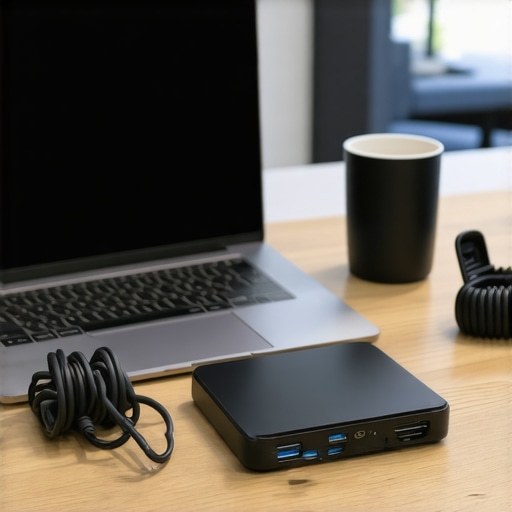
Experience has taught me that the ‘tech-heavy’ room will fail you at exactly 8:59 AM. Now, I carry a dedicated ‘Meeting Go-Bag’ that lives in my backpack. It contains a 10-foot braided HDMI cable, a multi-port USB-C hub, and—most importantly—a Jabra Speak 510 speakerphone. Why a separate speakerphone? Because built-in laptop mics are garbage in echoey rooms, and most conference room systems have a 50% chance of failing to sync with your specific OS version. By bringing my own hardware, I ensure a professional audio experience every single time, even if the building’s tech is prehistoric. This kit is a core part of the checklist for a glitch-free hybrid board meeting. When you’re the only person in the room who isn’t fumbling with cables or asking ‘Can you hear me now?’, you immediately command the room. It’s an easy, low-cost way to prep for a high-stakes board meeting without relying on the venue’s potentially outdated infrastructure. I also include a high-lumen portable LED light; bad lighting is the quickest way to look like an amateur on a 4K webcam.
What the next decade of office life looks like
I suspect we are moving toward a world where ‘office’ is a verb rather than a noun. We’ll see ‘AI-augmented acoustics’ built into every shared wall, where noise-canceling isn’t just in your ears but projected into your personal space. The trend is moving away from the mega-headquarters and toward ‘hyper-local’ hubs. We are already seeing why small satellite offices are beating the mega-headquarters in terms of employee retention and deep work focus. For the startup founder, this means your strategy should be modular. Don’t invest in real estate; invest in a network of access points that allow your team to congregate where the talent is, not where the lease is cheapest.
How do I keep my startup lean as the team grows?
Maintenance is the silent killer of startup runways. As your headcount climbs, you’ll be tempted to sign a three-year lease on a ‘grown-up’ office just to prove you’ve made it. Don’t fall for the vanity trap. The future of the workplace isn’t a fixed address; it’s a distributed network of high-quality hubs that offer flexibility. You need to know how to find an office space that grows with your hiring plan without locking you into a financial straitjacket. For now, the best way to maintain momentum is to keep your overhead variable. If you’re feeling the squeeze, try my ‘hardware-first’ approach: invest in the tools you can carry with you, rather than the walls you’ll eventually outgrow. Go ahead and audit your ‘Go-Bag’ today—make sure you have every adapter imaginable before your next investor pitch, and verify your endpoint security before you log on to that public hub again.
The Reality Check Most Founders Ignore Until It Costs Them
Looking back at my transition from a kitchen table to a dedicated hub, I realized that I was often my own worst enemy. First, stop romanticizing the ‘hustle’ of working in a loud cafe. It doesn’t make you look busy; it makes you look underfunded. I spent months thinking I was saving money, but when I finally calculated the true ROI of a premium coworking membership, the increased deal flow from having a professional setting paid for the desk ten times over. Second, remember that physical presence still matters for early-stage funding. Investors aren’t just betting on your code; they are betting on your ability to lead, and leaders don’t take board calls from a beanbag chair. Finally, I learned that networking isn’t about being the loudest person in the room; it is about networking without the awkwardness by simply being a reliable, consistent presence in the space.
Gear That Keeps You Professional When the Space Fails
No matter how fancy the venue, things will break. I rely on three specific tools to maintain my edge. First, Tailscale. It is my go-to for secure networking, turning any public Wi-Fi into a private fortress. Second, I always recommend reading ‘Deep Work’ by Cal Newport. It completely changed how I schedule my time in a shared environment, helping me protect my focus hours from the ‘communal energy’ trap. Third, the Jabra Speak 510. I have carried this in my bag for years because you cannot always trust a room’s built-in mic. If you want to know how to maximize productivity in your startup’s conference rooms, start by bringing your own reliable audio.
Your Business Deserves a Home That Works
The journey from a solo founder to a team leader is full of friction, but your workspace should not be the source of it. Choosing the right environment is about more than just a desk; it is about creating a container for your vision to grow. Whether you are hunting for a quiet corner or a high-tech boardroom, prioritize the tools and spaces that allow you to show up as the best version of yourself. Your coworking strategy should evolve as fast as your product does. Do not be afraid to leave the comfort of the common area and demand a space that actually respects your focus. Have you ever lost a lead or a client because of a technical glitch or a noisy environment? Let me know your horror stories in the comments below!