

I sat in one of those sleek, glass-walled conference rooms at 3 PM, staring at a “Notice of Termination” form that felt more like a confession of guilt. My startup was pivoting—fast—and I needed to cut our burn rate immediately to stay alive. I’d signed up for a “flexible” workspace membership thinking I could walk away with thirty days’ notice if things went south. I was dead wrong. The “flexibility” I bought into came with a hidden 60-day notice period and a non-refundable “restoration fee” I hadn’t noticed while I was busy admiring the ergonomic chairs. That oversight cost us nearly $5,000—money that should have gone toward our first developer hire or a marketing push. It was a painful lesson in reading the fine print.
Why “Flexible” Usually Means Anything But
[IMAGE_PLACEHOLDER] When we talk about the logic of choosing a flex office over a 5-year lease, we’re usually chasing agility. We want the freedom to grow—or shrink—without the weight of a traditional landlord on our backs. But here’s the cold truth I’ve learned after years in the startup ecosystem: coworking operators are businesses too, and empty desks are their greatest enemy. My early mistake was assuming that “no long-term commitment” meant “no strings attached.” It doesn’t. In fact, many high-end spaces make their real margins on the people who leave, not just the ones who stay. We need to stop overpaying for square footage you never use and start looking at the exit clause before we look at the free beer taps. If you’ve ever felt trapped by a contract you thought was supposed to set you free, you aren’t alone. It’s frustrating to feel like you’re being penalized for your business’s natural ebb and flow. I once talked to a fellow founder who had to keep paying for a 10-person suite for three months after his team went fully remote just because his “flex” contract required a 90-day lead time for any changes. That’s not agility; that’s a trap. Have you ever been blindsided by a “hidden” fee when trying to scale down your team?
Is a flex membership actually worth the hype?
It absolutely can be, but only if you know how to read between the lines. A surprising report by JLL indicates that while the flex market is booming, nearly 40% of corporate occupiers find the lack of standardized contracts a major hurdle to actual agility. This lack of standardization is exactly where the “gotcha” moments live. You think you’re getting a simple deal, but you’re actually navigating a minefield of “membership tiers” and “service fees” that change the math entirely. I’ve learned the hard way that why the all-inclusive membership is usually a trap often comes down to these exit barriers. If you’re not careful, the real cost of a free coffee meeting is actually the thousands you’ll pay in “decommissioning” fees for a desk you only used for six months. I want to help you avoid that. Before you sign anything, you need to know how to spot a predatory lease before you sign. Today, I’m going to show you how to choose an office that supports your scaling speed without the anchor of a bad lease dragging you down. We’re going to dive into the specific clauses that matter and how to negotiate them like a pro.
Stop Signing and Start Negotiating
Treat your flex office provider like a high-stakes vendor, not a landlord. The moment you treat them like a landlord, you lose your leverage. When I was looking for our second space, I walked in with a laptop and a speed-test tab already open because I knew that how to test the wi-fi speed before you book that venue is the difference between a productive Tuesday and a disastrous demo day. Negotiation in this space isn’t just about the monthly price; it is about the clauses that allow you to move at the speed of light.
Hunt Down the 90-Day Notice Trap
Most ‘flexible’ workspaces try to bake a 90-day exit clause into their agreements. For a startup, 90 days is a lifetime. I once flat-out refused a beautiful corner suite because they wouldn’t budge on this. Instead, I negotiated a slightly higher monthly rate in exchange for a 30-day notice period. Three months later, our main competitor got funded and we had to pivot and downsize immediately. That one negotiation saved us $12,000 in ‘dead’ rent. This is exactly why you shouldn’t sign a lease for your first 10 employees without a clear, short-term exit path. 
Slash the Bullshit Restoration Charges
Have you ever seen a ‘de-branding’ fee? It’s the coworking equivalent of a cleaning fee at a bad Airbnb. They’ll charge you $500 to take a vinyl logo off a glass door—a job that takes five minutes and a razor blade. When you are learning how to spot a predatory lease before you sign, look for any line item that mentions ‘restoration,’ ‘decommissioning,’ or ‘reinstatement.’ I now make it a rule to strike these out or cap them at a flat $100. It sounds small, but these ‘exit taxes’ are designed to bleed your remaining cash as you leave.
Run a Stress Test on the Hardware
Don’t just look at the furniture; test the infrastructure. During one tour, I asked the manager to let me sit in a phone booth for ten minutes. I realized the ventilation was so poor it felt like a sauna, and the soundproofing was non-existent. You need to know why your sales calls need a private phone booth that actually works before you commit your team to that environment. If the ‘private’ spaces aren’t private, you’ll be constantly dealing with the noise problem in open plan offices, which kills developer focus faster than a server crash. Always how to vet a conference room for client-facing speed by checking the AV setup yourself. If the HDMI cable is frayed or the dongles are missing during the tour, imagine the nightmare when you have a VC on the line.
The High Cost of Free Perks
Everyone tells you that a startup needs a culture, and usually, that means a workspace with a pool table, a craft beer tap, and maybe a rooftop garden. But after five years of moving teams between different hubs, I’ve realized that these amenities are often the biggest distractions from what actually matters: output. In my experience, the shiny objects in a coworking lobby are usually there to distract you from the fact that the actual desks are cramped and the acoustics are terrible. Does your office actually need a pool table? Probably not. In fact, research by the Leesman Index, which analyzes workplace effectiveness, consistently shows that basic functionality—like acoustic privacy and chair comfort—has a far higher impact on employee satisfaction than ‘fun’ perks. When you prioritize the ping-pong table over the air quality, you’re making a mistake that costs your developers focus every single day.
Why does your team feel drained by 3 PM in a ‘perfect’ room?
It often comes down to the subtle psychology of your environment. Most people think a meeting room is just four walls and a screen, but the layout and lighting dictate the energy of the room. I’ve seen teams flounder in high-end suites because the table was too long for collaboration or the windows caused a blinding glare on the monitors. You need to know how to maximize productivity in your startups conference rooms by 0245 pm before the afternoon slump hits. If your team is constantly hitting a wall, it’s likely why your teams productivity drops after two pm—the physical space is working against their circadian rhythms. 
Stop Falling for the All-Inclusive Illusion
The biggest myth in the industry is the ‘all-inclusive’ membership. It sounds great on a pitch deck: one price for everything. But in reality, why the all-inclusive membership is usually a trap is because it hides usage limits. I once signed a ‘premium’ deal only to find out that my ‘unlimited’ meeting room access was capped at 10 hours a month, with a $75/hour overage fee. That is a massive ‘oops’ factor for a team that does daily stand-ups. You should be looking for startup success secrets choosing the perfect conference room that doesn’t penalize you for actually using it. Also, pay attention to the shape of the furniture. It sounds pedantic, but why your meeting room layout is killing participation is often as simple as having a rectangular table that reinforces a hierarchy you’re trying to avoid. If you want a flat organization, you need a setup that reflects it. Have you ever fallen into this trap of paying for ‘premium’ features you couldn’t actually use? Let me know in the comments. Moving forward, always look at the infrastructure before the aesthetics; a reliable router is worth ten times more than a designer sofa when you’re trying to close a seed round.
I used to think that once the lease was signed and the desks were assigned, my job as a founder was done. I was wrong. The real work begins when the first person complains about the Wi-Fi dropping during a sprint or when the board meeting gets interrupted by the loud marketing team next door. You need a toolkit that keeps your operation lean but professional. If you don’t actively manage your environment, you’re just finding a workspace that doesn’t feel like a tech prison only to turn it into one yourself through poor maintenance. I’ve realized that the physical environment is just as much a part of our tech stack as our AWS instance.
The Hardware That Actually Closes Deals
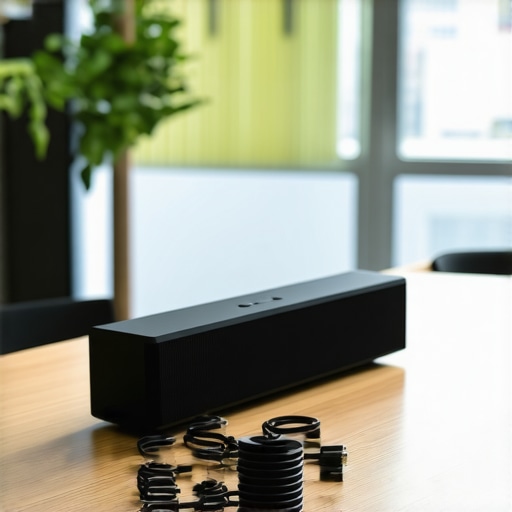
Forget the fancy coffee machines; if you want to win, invest in a portable conference speaker. I personally swear by the Jabra Speak series. Why? Because the built-in microphone on your MacBook is omnidirectional garbage in a glass-walled room. It picks up the echo of the walls and the chatter from the hallway, making you sound like you’re pitching from a bathroom. When you are how to prep for a high-stakes board meeting, having dedicated hardware ensures you sound like a Series B company even if you’re still in seed. A technical audit by the engineers at MetaGeek highlights that ‘co-channel interference’ in dense coworking hubs can degrade VoIP quality by up to 50% during peak hours, which is exactly what to do when the office wi-fi goes down mid-pitch is a scenario you must prepare for by having a dedicated 5G hotspot in your bag at all times.
Ditch the Glitchy Screen Sharing
We’ve all been there: fumbling with a Dongle for ten minutes while an investor stares at the wall. My rule now is ‘no wireless casting.’ It sounds old-school, but a high-quality, 10-foot 4K HDMI cable is the only way to ensure your product demo doesn’t lag. I’ve seen too many founders fail at hosting a product demo in a rented suite because the ‘smart’ TV decided to update its firmware right at 9:00 AM. If you want to know how to host a developer workshop without the lag, the answer is always hardwired connections. It’s about removing variables. The fewer things that can go wrong, the more you can focus on the narrative of your business.
Can you actually maintain a culture in a shared space over time?
It’s the question I get asked most by fellow founders. The truth is, your culture isn’t the walls; it’s the rituals you perform within them. We make it a point to use creative coworking transforming meeting rooms into collaboration hubs at 0455 pm for our Friday retrospectives. It keeps the team from feeling like they are just ‘renters.’ Looking ahead, I predict we will see the rise of ‘Spatial Intelligence’—AI-driven sensors that automatically adjust the lighting and temperature of your rented room based on the meeting’s intensity. Until then, you have to be the thermostat. My challenge to you: before your next big meeting, run a 30-second packet loss test on the network. If it’s over 2%, move the meeting or switch to your hotspot. It’s a small move that saves your reputation. I also recommend checking out how to stop your team from hating hybrid meetings to keep your remote staff feeling just as connected as the ones in the room.
I sat in one of those sleek, glass-walled conference rooms at 3 PM, staring at a “Notice of Termination” form that felt more like a confession of guilt. My startup was pivoting—fast—and I needed to cut our burn rate immediately to stay alive. I’d signed up for a “flexible” workspace membership thinking I could walk away with thirty days’ notice if things went south. I was dead wrong. The “flexibility” I bought into came with a hidden 60-day notice period and a non-refundable “restoration fee” I hadn’t noticed while I was busy admiring the ergonomic chairs. That oversight cost us nearly $5,000—money that should have gone toward our first developer hire or a marketing push. It was a painful lesson in reading the fine print.
Why “Flexible” Usually Means Anything But
[IMAGE_PLACEHOLDER] When we talk about the logic of choosing a flex office over a 5-year lease, we’re usually chasing agility. We want the freedom to grow—or shrink—without the weight of a traditional landlord on our backs. But here’s the cold truth I’ve learned after years in the startup ecosystem: coworking operators are businesses too, and empty desks are their greatest enemy. My early mistake was assuming that “no long-term commitment” meant “no strings attached.” It doesn’t. In fact, many high-end spaces make their real margins on the people who leave, not just the ones who stay. We need to stop overpaying for square footage you never use and start looking at the exit clause before we look at the free beer taps. If you’ve ever felt trapped by a contract you thought was supposed to set you free, you aren’t alone. It’s frustrating to feel like you’re being penalized for your business’s natural ebb and flow. I once talked to a fellow founder who had to keep paying for a 10-person suite for three months after his team went fully remote just because his “flex” contract required a 90-day lead time for any changes. That’s not agility; that’s a trap. Have you ever been blindsided by a “hidden” fee when trying to scale down your team?
Is a flex membership actually worth the hype?
It absolutely can be, but only if you know how to read between the lines. A surprising report by JLL indicates that while the flex market is booming, nearly 40% of corporate occupiers find the lack of standardized contracts a major hurdle to actual agility. This lack of standardization is exactly where the “gotcha” moments live. You think you’re getting a simple deal, but you’re actually navigating a minefield of “membership tiers” and “service fees” that change the math entirely. I’ve learned the hard way that why the all-inclusive membership is usually a trap often comes down to these exit barriers. If you’re not careful, the real cost of a free coffee meeting is actually the thousands you’ll pay in “decommissioning” fees for a desk you only used for six months. I want to help you avoid that. Before you sign anything, you need to know how to spot a predatory lease before you sign. Today, I’m going to show you how to choose an office that supports your scaling speed without the anchor of a bad lease dragging you down. We’re going to dive into the specific clauses that matter and how to negotiate them like a pro.
Stop Signing and Start Negotiating
Treat your flex office provider like a high-stakes vendor, not a landlord. The moment you treat them like a landlord, you lose your leverage. When I was looking for our second space, I walked in with a laptop and a speed-test tab already open because I knew that how to test the wi-fi speed before you book that venue is the difference between a productive Tuesday and a disastrous demo day. Negotiation in this space isn’t just about the monthly price; it is about the clauses that allow you to move at the speed of light.
Hunt Down the 90-Day Notice Trap
Most ‘flexible’ workspaces try to bake a 90-day exit clause into their agreements. For a startup, 90 days is a lifetime. I once flat-out refused a beautiful corner suite because they wouldn’t budge on this. Instead, I negotiated a slightly higher monthly rate in exchange for a 30-day notice period. Three months later, our main competitor got funded and we had to pivot and downsize immediately. That one negotiation saved us $12,000 in ‘dead’ rent. This is exactly why you shouldn’t sign a lease for your first 10 employees without a clear, short-term exit path.
Slash the Bullshit Restoration Charges
Have you ever seen a ‘de-branding’ fee? It’s the coworking equivalent of a cleaning fee at a bad Airbnb. They’ll charge you $500 to take a vinyl logo off a glass door—a job that takes five minutes and a razor blade. When you are learning how to spot a predatory lease before you sign, look for any line item that mentions ‘restoration,’ ‘decommissioning,’ or ‘reinstatement.’ I now make it a rule to strike these out or cap them at a flat $100. It sounds small, but these ‘exit taxes’ are designed to bleed your remaining cash as you leave.
Run a Stress Test on the Hardware
Don’t just look at the furniture; test the infrastructure. During one tour, I asked the manager to let me sit in a phone booth for ten minutes. I realized the ventilation was so poor it felt like a sauna, and the soundproofing was non-existent. You need to know why your sales calls need a private phone booth that actually works before you commit your team to that environment. If the ‘private’ spaces aren’t private, you’ll be constantly dealing with the noise problem in open plan offices, which kills developer focus faster than a server crash. Always how to vet a conference room for client-facing speed by checking the AV setup yourself. If the HDMI cable is frayed or the dongles are missing during the tour, imagine the nightmare when you have a VC on the line.
The High Cost of Free Perks
Everyone tells you that a startup needs a culture, and usually, that means a workspace with a pool table, a craft beer tap, and maybe a rooftop garden. But after five years of moving teams between different hubs, I’ve realized that these amenities are often the biggest distractions from what actually matters: output. In my experience, the shiny objects in a coworking lobby are usually there to distract you from the fact that the actual desks are cramped and the acoustics are terrible. Does your office actually need a pool table? Probably not. In fact, research by the Leesman Index, which analyzes workplace effectiveness, consistently shows that basic functionality—like acoustic privacy and chair comfort—has a far higher impact on employee satisfaction than ‘fun’ perks. When you prioritize the ping-pong table over the air quality, you’re making a mistake that costs your developers focus every single day.
Why does your team feel drained by 3 PM in a ‘perfect’ room?
It often comes down to the subtle psychology of your environment. Most people think a meeting room is just four walls and a screen, but the layout and lighting dictate the energy of the room. I’ve seen teams flounder in high-end suites because the table was too long for collaboration or the windows caused a blinding glare on the monitors. You need to know how to maximize productivity in your startups conference rooms by 0245 pm before the afternoon slump hits. If your team is constantly hitting a wall, it’s likely why your teams productivity drops after two pm—the physical space is working against their circadian rhythms.
Stop Falling for the All-Inclusive Illusion
The biggest myth in the industry is the ‘all-inclusive’ membership. It sounds great on a pitch deck: one price for everything. But in reality, why the all-inclusive membership is usually a trap is because it hides usage limits. I once signed a ‘premium’ deal only to find out that my ‘unlimited’ meeting room access was capped at 10 hours a month, with a $75/hour overage fee. That is a massive ‘oops’ factor for a team that does daily stand-ups. You should be looking for startup success secrets choosing the perfect conference room that doesn’t penalize you for actually using it. Also, pay attention to the shape of the furniture. It sounds pedantic, but why your meeting room layout is killing participation is often as simple as having a rectangular table that reinforces a hierarchy you’re trying to avoid. If you want a flat organization, you need a setup that reflects it. Have you ever fallen into this trap of paying for ‘premium’ features you couldn’t actually use? Let me know in the comments. Moving forward, always look at the infrastructure before the aesthetics; a reliable router is worth ten times more than a designer sofa when you’re trying to close a seed round.
I used to think that once the lease was signed and the desks were assigned, my job as a founder was done. I was wrong. The real work begins when the first person complains about the Wi-Fi dropping during a sprint or when the board meeting gets interrupted by the loud marketing team next door. You need a toolkit that keeps your operation lean but professional. If you don’t actively manage your environment, you’re just finding a workspace that doesnt feel like a tech prison only to turn it into one yourself through poor maintenance. I’ve realized that the physical environment is just as much a part of our tech stack as our AWS instance.
The Hardware That Actually Closes Deals
Forget the fancy coffee machines; if you want to win, invest in a portable conference speaker. I personally swear by the Jabra Speak series. Why? Because the built-in microphone on your MacBook is omnidirectional garbage in a glass-walled room. It picks up the echo of the walls and the chatter from the hallway, making you sound like you’re pitching from a bathroom. When you are how to prep for a high-stakes board meeting, having dedicated hardware ensures you sound like a Series B company even if you’re still in seed. A technical audit by the engineers at MetaGeek highlights that ‘co-channel interference’ in dense coworking hubs can degrade VoIP quality by up to 50% during peak hours, which is exactly what to do when the office wi-fi goes down mid-pitch is a scenario you must prepare for by having a dedicated 5G hotspot in your bag at all times.
Ditch the Glitchy Screen Sharing
We’ve all been there: fumbling with a Dongle for ten minutes while an investor stares at the wall. My rule now is ‘no wireless casting.’ It sounds old-school, but a high-quality, 10-foot 4K HDMI cable is the only way to ensure your product demo doesn’t lag. I’ve seen too many founders fail at hosting a product demo in a rented suite because the ‘smart’ TV decided to update its firmware right at 9:00 AM. If you want to know how to host a developer workshop without the lag, the answer is always hardwired connections. It’s about removing variables. The fewer things that can go wrong, the more you can focus on the narrative of your business.
Can you actually maintain a culture in a shared space over time?
It’s the question I get asked most by fellow founders. The truth is, your culture isn’t the walls; it’s the rituals you perform within them. We make it a point to use creative coworking transforming meeting rooms into collaboration hubs at 0455 pm for our Friday retrospectives. It keeps the team from feeling like they are just ‘renters.’ Looking ahead, I predict we will see the rise of ‘Spatial Intelligence’—AI-driven sensors that automatically adjust the lighting and temperature of your rented room based on the meeting’s intensity. Until then, you have to be the thermostat. My challenge to you: before your next big meeting, run a 30-second packet loss test on the network. If it’s over 2%, move the meeting or switch to your hotspot. It’s a small move that saves your reputation. I also recommend checking out how to stop your team from hating hybrid meetings to keep your remote staff feeling just as connected as the ones in the room.
The Hard Truth About My Pivot from Flex to Real Agility
After years of bouncing between high-end hubs, I realized that the most expensive office isn’t the one with the highest rent; it is the one you can’t leave when your business model changes. Startups don’t grow in linear paths, and assuming your space needs will be the same in six months is a rookie error. When you finally make the move from garage to office a growth roadmap that actually fits your burn rate, you stop looking at the neon signs and start looking at the fine print on the exit clauses. Even for remote-first teams, why your startup needs a physical anchor for its remote team is about creating a sense of permanence in a world of Slack pings. Don’t settle for a space that treats you like a tenant; find one that acts as a partner.
My Survival Kit for Pitching from Someone Elses Office
You have to control your own environment because the workspace provider certainly won’t do it for you. I never walk into a high-stakes meeting without my own kit. Beyond the Jabra speaker and the 4K HDMI cable, I always carry a high-quality privacy screen for my laptop. Protecting your IP by knowing how to keep your startups trade secrets in an open office is vital when the team at the next table might be building your direct competitor. It is also worth investigating the true roi of a premium coworking membership. Sometimes, spending that extra $150 a month for guaranteed quiet-zone access and prioritized tech support saves you thousands in lost momentum during a launch week.
Building a Culture That Outlasts the Lease
At the end of the day, your company’s legacy won’t be defined by the designer furniture in your suite. It will be defined by the speed at which your team can collaborate and ship code. As we see how coworking spaces unlock innovation top meeting rooms of 2025 at 1123 am, remember that you are the captain of your physical surroundings. Use these flexible tools to stay lean, stay fast, and stay focused on the product. Go find a space that moves as fast as your roadmap demands. Have you ever found a ‘hidden gem’ feature in a coworking space that totally changed how your team worked? Let me know in the comments below.