
I’ll never forget the morning I sat alone in my ‘executive’ office, staring at ten empty workstations and a silent coffee machine. It was 10:00 AM on a Wednesday. I had signed a three-year lease for 1,500 square feet because I thought that’s what successful startups did. Instead of feeling like a boss, I felt like a landlord for a ghost town. My team was scattered—some at home, others at local cafes—and I was stuck with a massive monthly bill for air. [IMAGE_PLACEHOLDER] This realization was my turning point. Today, I’m going to show you why chasing square footage is a trap and how a flexible membership can actually save your sanity (and your runway). Have you ever felt the sting of paying for space that nobody actually uses?
The Moment I Realized Square Footage is a Vanity Metric
For years, I believed the lie that more space meant more growth. I made the classic rookie mistake of prioritizing a ‘big’ footprint over an agile one. I even ignored several red flags in our lease just to get into a trendy building. It was a disaster. According to data from JLL’s 2024 office outlook, traditional office utilization has dropped significantly, yet many founders still cling to the five-year lease model. The logic of choosing a flex office over a rigid contract became clear when our team size fluctuated by 40% in a single quarter.
Does Flexible Membership Actually Cost More in the Long Run?
I know what you’re thinking. You’re worried that ‘flexibility’ is just a fancy word for ‘more expensive per square foot.’ It’s the biggest hurdle for most founders. But when you factor in furniture, high-speed fiber, and the real cost of managing an office, the math flips. You need to stop overpaying for square footage you never use and start paying for the ability to pivot. In this post, we’re breaking down how to pick a membership that scales with your actual needs, not your ego.
Audit Your Real Headcount Every Thirty Days
Start by tracking who actually shows up to the office. I spent six months paying for a dozen dedicated desks when only four people ever came in on the same day. It was a waste of nearly $4,000 a month. Now, I recommend a ‘hot desk’ base with a few dedicated seats for your core team. This allows you to choose an office that supports your scaling speed without the financial bloat. Think of it like cloud computing for your physical space; you only pay for the ‘compute’ or desks your team actually consumes during a specific sprint. If you aren’t auditing this monthly, you are essentially donating money to a landlord who doesn’t need it.
Verify the Tech Stack Before the Contract Starts
Don’t trust the glossy sales brochure. I once moved a team of six developers into a beautiful space only to realize the ‘high-speed internet’ was a shared consumer-grade Wi-Fi router that died whenever someone pushed a large commit to GitHub. You must vet a space for high-speed fiber before you sign the contract. Bring a laptop, run a speed test during peak hours—usually around 2:00 PM—and check for dead zones in the corners. If the community manager won’t let you test the network or plug into an ethernet port, that is one of the major 7 red flags to watch for during a space tour. Reliable infrastructure is the non-negotiable foundation of a functional startup hub.

Protect Your Professionalism During High-Stakes Moments
My biggest mistake during our early days was thinking ‘flexibility’ meant ‘casual everything.’ During a critical seed round, I tried to pitch a partner from a communal lounge area because I didn’t want to spend the extra credits on a private room. The screech of a milk steamer drowned out my entire explanation of our CAC-to-LTV ratio. It was embarrassing and made us look amateur. Since then, I’ve realized why your investor pitch needs a neutral meeting room. These spaces aren’t just for internal brainstorming; they are tools to control the environment. When you need to discuss equity splits or difficult departures, you must know how to handle a sensitive HR meeting in a shared space—and that always starts with a booking a room with a door that actually shuts and soundproofing that works.
Master the Art of the Flex Negotiation
Most founders treat the sticker price on a coworking website as absolute law. It’s not. Coworking managers have monthly quotas just like any other sales representative. I’ve found that how to negotiate a better deal on monthly memberships often comes down to commitment length versus desk quantity. If you can’t commit to a year, offer to pay three months upfront for a 15% discount. Or, ask them to waive the setup fees in exchange for a public shout-out on your company’s LinkedIn. It keeps your runway clean and your accountant happy while giving you the high-end amenities you actually need to grow.
Stop Choosing Rooms Based on the View
Most founders make the mistake of thinking a leather-bound ‘Executive Boardroom’ with a view of the skyline will close the deal. In reality, these formal environments often create a power imbalance that can stifle collaboration. I’ve seen more breakthroughs happen in a room with writable walls and modular furniture than in a mahogany-paneled tomb. If you want results, you must vet a conference room for client-facing speed and functional utility over aesthetics. The goal is a space that facilitates movement, not one that encourages people to sink into heavy chairs and wait for the meeting to end.
Is Your Meeting Room Layout Actually Killing Participation?
It’s a nuance few consider until it’s too late: the physical arrangement of a room dictates the psychological flow of the conversation. A study published in the Journal of Environmental Psychology indicates that circular or U-shaped seating arrangements significantly increase the quantity and quality of group contributions compared to traditional rectangular setups. If your team feels silent during brainstorms, why your meeting room layout is killing participation might be the answer. I’ve found that the secret to productive brainstorming sessions away from the office is often just finding a space that doesn’t feel like a courtroom.

The Open-Plan Fallacy and the Developer Flow
Everyone says the open-plan office is great for ‘synergy,’ but for your technical talent, it’s a productivity killer. According to research cited by The Harvard Business Review, open offices can actually reduce face-to-face interaction by up to 70% as people retreat behind noise-canceling headphones to find peace. This is exactly why the open-plan office is failing your developers. If your engineers are constantly fighting for quiet, you aren’t saving money; you’re burning it in lost ‘deep work’ hours. You need to ensure your space has designated quiet zones or private pods before you commit to a long-term membership.
Avoid the All-Inclusive Amenity Trap
The ‘Oops’ factor for many young companies is falling for the ‘all-inclusive’ pitch. You see the kombucha taps, the massage chairs, and the rooftop yoga, and you think you’re getting a deal. However, why the all-inclusive membership is usually a trap becomes clear when you realize you’re paying a 30% premium for amenities your team only uses twice a year. I learned the hard way that a lean startup needs high-speed fiber and reliable coffee, not a ping-pong table that collects dust. Have you ever fallen into this trap and paid for ‘extras’ that actually distracted your team? Let me know in the comments. By focusing on the essentials first, you can keep your overhead low while still providing a professional environment that fosters real growth.
Once you’ve escaped the vanity metric trap, the real challenge begins: maintaining operational excellence when you do not own the walls. I used to think the community manager was my IT department. They are not. They are there to keep the coffee hot, not to troubleshoot your VPN. This is why I personally obsess over our portable tech stack. Every time we enter a new space, the first thing I do is deploy our own security layer. You cannot rely on a shared SSID for sensitive work. I personally use Tailscale because it creates a private mesh network that behaves as if we are all in the same room, regardless of the local Wi-Fi’s quirks. This is exactly why endpoint protection services matter more when your team is hybrid. If you are not protecting your data at the device level, you are essentially leaving your filing cabinet open in the lobby. According to Cloudflare’s technical documentation on Zero Trust architecture, moving away from ‘castle-and-moat’ security to identity-based verification is the only way to stay safe in a shared environment.
How do I keep my team’s momentum steady in a shared space?
It is easy to get distracted by the social energy of a hub, but you have to protect your deep work hours. I use a traffic light system on my desk—a simple physical puck that glows red when I am in focus mode. It sounds simple, but it is the only way I found how to keep your focus when the coworking hub is packed. We also treat our weekly anchor day as sacred. Even if we are mostly remote, why your startup needs a physical anchor for its remote team becomes obvious the moment you see the speed of decision-making that happens over a shared lunch versus a Slack thread. One tool I refuse to compromise on is a dedicated 360-degree camera and microphone for hybrid meetings. I use the Owl Labs Meeting Owl. The bowling alley view of a long conference table makes remote participants feel like second-class citizens. When we have a high-stakes sync, I ensure we have the exact lighting setup for professional video pitches, even in a rental room. It removes the temporary feel of our operations and shows investors we are a permanent fixture, even if our lease is month-to-month. 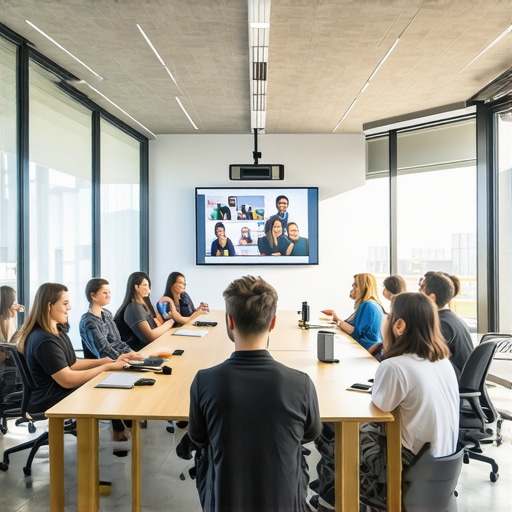 Looking ahead, I predict a massive shift toward AI-aware conference rooms that automatically transcribe, summarize, and assign action items based on spatial audio. We are moving toward a world where the physical space is just an interface for our digital workflows. If you want to stop feeling like a guest in your own office, do this today: Audit your team’s hardware. If they are still relying on laptop speakers and public Wi-Fi, you are not a tech company—you are a group of people at a library. Invest in a dedicated mobile router and high-quality peripherals to reclaim your professional edge.
What My Empty Office Taught Me About Team Momentum
Reflecting on those early days in a ghost-town office, I realize the biggest mistake wasn’t just the financial burn; it was the psychological weight of a static environment. I’ve learned that agility is a competitive advantage that a five-year lease simply cannot provide. First, never underestimate the power of serendipity in a shared hub. Being in a professional environment means you are often just one coffee machine conversation away from a potential partner or your next lead developer. Second, your office should feel like a specialized tool, not a recurring burden. If the walls around you aren’t actively helping you close deals or ship code, they are dead weight. Third, always have a technical backup plan; understanding the logic of choosing a flex office saved us from a massive overhead crisis when we had to pivot our entire product line in a single month.
[IMAGE_PLACEHOLDER]
The Toolkit That Keeps My Team Agile
To make the most of a flexible setup, you need gear that travels as fast as your ideas. I personally swear by Tailscale for secure networking; it ensures that why endpoint protection services matter more when your team is hybrid is a core part of your daily workflow rather than an afterthought. For hybrid meetings, the Meeting Owl is my non-negotiable choice to prevent remote workers from feeling like outsiders in the room. I also highly recommend every founder reads ‘Deep Work’ by Cal Newport to help their team master why developers need quiet zones to reach deep flow, especially in open-plan settings. Finally, always keep a portable lighting setup for professional video pitches in your gear bag to turn even the most basic rental room into a high-end broadcast studio.
Reclaim Your Runway and Your Sanity
Choosing a flexible membership isn’t just about saving on monthly rent; it’s about giving your startup the permission to breathe and grow at its own pace. You don’t need a three-year commitment to prove you’re a ‘real’ company; you need a product that people love and a team that isn’t burnt out by a commute to a sterile, empty headquarters. When you learn how to tell if a coworking membership is worth the price, you stop being a tenant and start being a strategist. It is time to build your empire without being tethered to a floor plan that doesn’t fit your future. What’s the one feature you absolutely won’t compromise on when choosing a shared space for your team? Let me know in the comments below!