
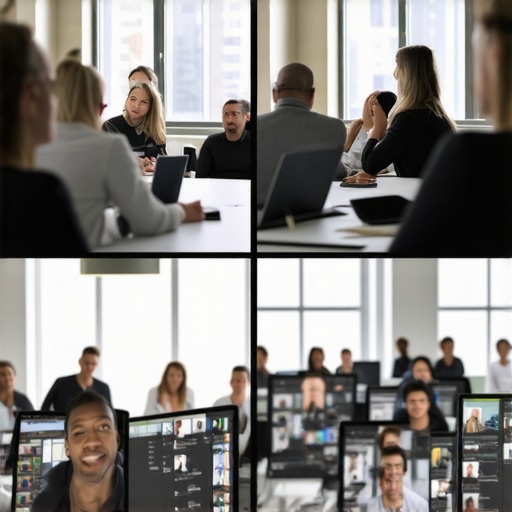
I remember sitting in a sleek, glass-walled conference room back in 2022, looking at a dozen faces on a massive TV screen. We had the best tech, the best snacks, and the most comfortable chairs. But there was this weird, invisible wall. The people in the room were cracking jokes about the local traffic, while the folks on the screen just sat there, muted, waiting for the “real” meeting to start. It was a total failure of leadership on my part. I realized right then that our culture wasn’t a shared vibe; it was a geography problem. If you’ve felt that awkward “us vs. them” tension during a weekly sync, believe me, you aren’t alone.
The Day I Realized Pizza Parties Don’t Work for Zoom
Early in my journey of managing a split team, I made the classic mistake of thinking culture was something you could buy and ship in a box. I sent out branded hoodies and organized virtual happy hours that everyone secretly hated. I ignored the fact that why your hybrid team is still failing at internal communication often comes down to the small, human moments we miss when we aren’t in the same physical space. We were functionally a team, but emotionally, we were strangers sharing a Slack channel. Today, I want to share exactly how we moved past the “postage stamp” video calls and built a culture that actually sticks, regardless of whether you’re at a standing desk in the city or a kitchen table in the suburbs.
[image_placeholder_1]
Does culture actually need an office to survive?
It’s the question every founder asks themselves when they see the rent bill for scaling a hybrid team without a corporate HQ. You might be skeptical. Can people really feel connected through a fiber-optic cable? The answer is yes, but it requires a massive shift in how you view your “workplace.” Surprisingly, a 2024 Gallup report found that hybrid employees often show the highest engagement rates—around 81%—but only when the organization is hyper-intentional about connection. Culture isn’t about where you sit; it’s about how you interact when you aren’t talking about deliverables.
Why You Need a Physical Anchor for Your Digital Spirits
One of the biggest hurdles we faced was the lack of a “home base.” Even if your team is mostly remote, why your startup needs a physical anchor becomes obvious the moment you try to brainstorm a complex new feature over a laggy video call. We started using local hubs to bring people together for high-impact days, focusing on how to create a collaborative culture within a shared office during those rare face-to-face moments. It changed everything. Have you ever felt like your remote team is slowly drifting away from the company’s core mission? I’d love to hear how you’re handling that gap—drop me a message and let’s compare notes. We’re about to dive into the tactical steps to make your hybrid setup feel like a single, unified powerhouse.
Ditch the Digital Distance with High-Stakes Syncs
Execution is where most hybrid cultures crumble. You can’t just hope for connection; you have to engineer it like a product launch. I used to think a weekly Zoom call was enough, but I was wrong. We shifted to a ‘rhythm of proximity.’ This means every six weeks, we stop the remote grind and gather for what I call the ‘Context Reset.’ We don’t do status updates; we do deep work that requires high bandwidth. If you’re struggling to keep people aligned, why founders are moving back to physical brainstorming sessions becomes the playbook for survival. It’s about creating a space where the nuance isn’t lost in a 150ms lag.
Why Your Best Ideas Need Four Walls and a Whiteboard
Let me tell you about the ‘Great Product Pivot’ of 2023. We spent four frustrating hours on a digital whiteboard tool trying to redesign our checkout flow. By the end, half the team was checking their email and the other half was just confused. The next morning, I booked a local hub and we gathered in person. In just 45 minutes, we had the entire flow mapped out on a physical glass wall with sticky notes. That’s when it clicked: why physical collaboration still beats video calls for startups isn’t just about the tools, it’s about the energy in the room. You can’t replicate the spark of someone jumping up to correct a diagram in real-time through a webcam.
Pick the Right War Room for the Right Battle
Don’t just grab a table at a coffee shop and expect magic. Why your pitch fails in a noisy lobby applies to your internal strategy sessions too. You need a dedicated environment that screams ‘focus.’ When I’m looking for a spot, I look for the difference between a standard meeting room and a real war room—the latter has the tech, the privacy, and the literal space to breathe.  This is where the ‘meat’ of your culture is cooked. It’s in the shared frustration of a hard problem and the collective sigh of relief when you solve it together. To maximize these moments, learn how to maximize productivity in your startups conference rooms by preparing an agenda that only includes items that require the human element. If it can be a Slack message, keep it a Slack message. If it needs a soul, get in a room.
Stop Talking Past Each Other in the Chat
The silent killer of hybrid culture is ‘proximity bias,’ where people in the office make decisions while the remote folks are left in the dark. We solved this by implementing a ‘Digital First’ rule for documentation. Even if we’re all sitting in a perfect conference room for business success, every decision is logged in a public channel immediately. It stops the ‘us vs. them’ narrative before it starts. If you find your team is still drifting apart, check why your hybrid team is still failing at internal communication to see if you’ve missed the documentation layer. It’s the invisible bridge that keeps the remote world connected to the physical one.
But here is where most founders trip up: they treat a meeting room like a commodity rather than a specialized tool. I’ve seen teams spend thousands on luxury office suites for routine syncs, only to try and save a few dollars by holding a high-stakes investor pitch in a noisy lobby. It is a fundamental misunderstanding of environmental psychology. Most people believe that any room with a door provides enough privacy, but in my experience, the ‘vibe’ and technical specs of the room dictate the outcome before you even open your laptop. Have you ever fallen into the trap of booking a space that looked great on a website but felt like a cold fishbowl in person? Let me know in the comments; I’ve definitely been there.
The expensive mistake of treating every meeting room like a generic box
The most common error is failing to vet a meeting room for acoustic privacy before booking. If you can hear the person in the next room ordering a latte, they can hear your trade secrets. This is the ‘Oops’ factor that kills startups. I once sat through a sensitive strategy session where we could clearly hear the neighboring company discussing their layoffs. It completely killed our momentum because we were terrified of being overheard. Beyond just noise, you need to look at choosing the perfect conference room through the lens of the specific task at hand. A creative brainstorm needs vertical space (whiteboards), while a board meeting needs a sense of weight and authority.
How do you stop a brainstorming session from turning into a polite waste of time?
The secret isn’t just the agenda; it’s the physical constraints of the room. A study published in the Journal of Environmental Psychology suggests that ceiling height actually influences human thought processes: higher ceilings encourage relational, abstract thinking, while lower ceilings are better for detail-oriented tasks. When we moved our creative sprints to rooms with high ceilings and natural light, our breakthrough rate tripled. If you’re still using the same cramped basement for every type of work, you’re fighting against your own biology. This is why the future of conference rooms in startup ecosystems is moving toward task-specific architecture.

Why your team actually hates those ‘free’ coffee perks
Everyone talks about the amenities, but let’s be real: the truth about free perks you never actually use is that they often mask poor infrastructure. I’d trade a thousand free muffins for a rock-solid fiber connection and a monitor that doesn’t require three different dongles to connect. When you’re looking at a space, ignore the ping-pong table. Instead, focus on the acoustic fix for echoey conference rooms or the quality of the chairs. If you’re planning to be in a room for six hours, that ‘designer’ stool will become your worst enemy by hour two. If you need to handle a sensitive HR meeting in a shared space, the aesthetic doesn’t matter nearly as much as the soundproofing and the layout of the exit. It’s about building a space that respects the work being done inside it.
I’ve learned the hard way that the invisible friction of a bad setup is a silent killer. We used to waste fifteen minutes of every hour-long sync just trying to get the screen to share or the audio to stop echoing. If you aren’t careful, the hidden drag of slow office wi-fi on your burn rate will eat your productivity alive before you even hit your first milestone. Now, I refuse to book any space without first knowing how to vet a space for high-speed fiber before you sign the contract. It sounds like a small detail, but when you’re pushing code or streaming a high-def product demo, it is the difference between looking like a pro and looking like a hobbyist.
The tech stack that finally killed our meeting lag
I’m obsessed with a ‘zero-friction’ environment. That means having chargers exactly where you need them. One of the reasons we chose our current hub was because of the thoughtful touches, like why our private office suites stock extra Surface Pro chargers for members. It eliminates that mid-meeting panic when a laptop dies. We also stopped relying on the built-in TV speakers and started bringing our own portable 360-degree microphone. According to the ISO 22955 standard, which focuses on acoustic quality in open offices, managing the ‘distraction distance’ is key to maintaining focus. By using a dedicated mic, we ensure the remote team hears only the person speaking, not the background hum of the HVAC.
How do I maintain a consistent culture as the team grows?
Keeping that initial ‘garage’ energy alive during a scale-up is incredibly difficult. You have to move from accidental connection to intentional systems. I’ve found that the role of flex space in a modern business scaling strategy is the secret weapon here. Instead of locking ourselves into a five-year lease that we’ll outgrow in twelve months, we use memberships that breathe with us. This is why why membership flexibility is more important than square footage for any company in the hyper-growth phase. It allows you to add ‘war rooms’ for specific projects without the overhead of a massive permanent headquarters. 
Why I stopped worrying about square footage
We used to think a ‘real’ company needed a lobby with a receptionist. Now I know that the logistics of scaling a hybrid team without a corporate HQ are actually more efficient. We invest the money we save on rent back into high-quality offsites. Looking forward, I predict the future of conference rooms in startup ecosystems will involve integrated AI that automatically summarizes whiteboards and tracks action items in real-time. We are moving toward a ‘spatial-as-a-service’ model where the room itself is an active participant in the meeting. If you want to stay ahead, stop looking for desks and start looking for hubs that facilitate high-bandwidth human interaction. My challenge to you this week: identify the one recurring technical glitch that frustrates your remote team and fix it with a hardware solution, not another software patch. Reach out to us if you need help finding a space that actually supports your tech stack.
The Lessons I Learned the Hard Way While Scaling Remotely
Building a team across time zones isn’t just a logistical challenge; it is a psychological one. Looking back on those early days in the glass conference room, I realized that culture is built in the gaps between tasks. First, I learned that documentation is your only true source of truth. If a decision wasn’t written down in a shared doc, it never happened. Second, never underestimate how much a physical space influences the quality of a brainstorm. I’ve seen more breakthroughs happen in a room with a high-quality whiteboard than in a thousand Slack threads. Lastly, you have to how to manage noise complaints in a shared workspace before they turn into resentment. A quiet team is a focused team, and protecting that focus is a leadership priority.
My Go-To Toolkit for Frictionless Collaboration
I don’t believe in gadgets for the sake of gadgets, but these three things have saved my sanity more than once. Jabra Speak Speakerphones are my first recommendation; they pick up every voice in the room so the remote folks never feel left out. Second, I swear by the Miro digital whiteboard, but only when paired with a massive physical screen in the office so the two worlds can merge. Finally, I always look for hubs that understand how to pick an office that fits your startups growth pace. You need a partner, not just a landlord. These tools work because they remove the ‘friction’ of being hybrid, allowing the actual work to take center stage.
[image_placeholder_final]
Build a Culture That Outlasts Your Current Lease
At the end of the day, your team doesn’t care about the fancy coffee as much as they care about feeling seen and heard. Whether you are navigating the logistics of scaling a hybrid team without a corporate HQ or you’re just trying to get through a Monday morning sync without a tech glitch, remember that the environment you choose is a reflection of your respect for their time. Treat your hybrid team culture as your most important product. Iterate on it, fix the bugs, and never settle for a ‘good enough’ connection. If you’re ready to find a space that actually matches your ambition, reach out to us and let’s get your team into a room that works. What is the one thing that always seems to go wrong during your hybrid meetings? Let me know in the comments below!