

I was sitting on a crate of spare tires when I realized our ‘scrappy startup’ vibe had become a liability. We were on a high-stakes Zoom call with a potential partner, and my neighbor started leaf blowing right outside the garage door, effectively muting my entire pitch. My co-founder looked at me through a grainy webcam, and I knew: we couldn’t scale a 20-person vision from a two-car garage. It wasn’t just about the physical space; it was about the psychological shift from playing business to actually running one. We needed a place where the Wi-Fi didn’t drop when someone used the microwave and where our conference room wasn’t just a cleared-off workbench.
The Day the Garage Stopped Being Charming
We’ve all heard the legends of Apple and Amazon starting in garages, but they don’t tell you about the logistics nightmare of growing past three people in a space meant for a sedan. I made the classic mistake early on of thinking that low overhead was the only metric that mattered. I ignored the fact that my lead developer was burning out because he had no quiet space, and our strategy sessions happened at a local coffee shop where we had to fight for a power outlet. If you’re currently scaling from 2 to 20, you’ve probably felt that same pinch. Today, I’m going to share the path we took to find a home for our team that didn’t require a five-year lease but gave us room to breathe. We’re going to solve the ‘where do we go next’ puzzle together, based on the lessons I learned while moving from a garage to a flex office.
Is a dedicated office actually worth the hype?
I get it. Every dollar counts when you’re pre-revenue or just hit your first milestone. You might think, ‘Why pay for desks when we can work from home?’ The skepticism is healthy. But here’s the truth: the cost of a bad first impression is often higher than a monthly membership. When we were hiding our location, we were also hiding our potential. A study by the Harvard Business Review found that a face-to-face request is 34 times more successful than an email. You can’t get that kind of conversion rate when you’re afraid to invite a client over because your office smells like old boxes. [image_placeholder]
Stop Letting Your Living Room Kill Your Credibility
There is a specific kind of confidence that comes from walking into a space designed for work. When we finally moved, we realized that why investors prefer meeting in a high-energy hub isn’t just about the free espresso—it’s about the atmosphere of momentum. In the garage, we were isolated. In a professional hub, we were surrounded by other people doing big things, and that energy is contagious. Before we go further, tell me: what’s the most embarrassing thing that’s happened during a professional call from your home office or garage? I once had a delivery driver walk right into the background of my pitch while I was in my sweatpants. It was a wake-up call. We needed a real checklist for moving our startup, and we needed it fast. Let’s look at how we finally professionalized our workspace without breaking the bank.
Run This Audit Before You Spend a Dime
Before you start touring glass-walled offices, you need to know exactly why the garage is failing you. I used to think we just needed ‘more space,’ but when I sat down for the 10-minute audit to see if your office space is wasting money, I realized our bottleneck wasn’t square footage—it was acoustics and connectivity. I once spent forty minutes trying to reconnect a router during a live demo while my lead engineer sat there sweating. That wasn’t just a tech glitch; it was a billable hour disaster. Map out your team’s actual day. Do they need private pods for deep work, or are they constantly collaborating? If you’re mostly digital, you might realize the role of flex space in a modern business scaling strategy is much more cost-effective than a traditional suite.
Don’t Sign That Five-Year Lease Just Yet
The biggest trap I see founders fall into is the ‘ego lease.’ You want your name on the door of a 60-month contract to feel legitimate. Stop. I almost signed one for a dusty corporate park until I realized why your first office shouldnt be a 5-year commitment. Startups are living organisms; they grow and shrink. Instead, look for a membership that allows you to scale up. We started with a few dedicated desks and eventually moved into a private pod as we hired. If you’re unsure, you can always how to use a day pass to test your next potential office. We spent three days at different hubs before committing, and it’s the only reason we didn’t end up in a place that smelled like old gym socks and bad coffee.
Pick a Room That Doesnt Kill Your Pitch
If you are bringing investors in, the environment does 90% of the heavy lifting. I remember one pitch where the ‘conference room’ was basically a closet with a flickering light. The investor spent the whole time looking at the ceiling, not my deck. To avoid this, you need to know how to find a conference room that actually has working adapters and professional lighting. Use the acoustics hack for crystal clear client pitches by checking for soft surfaces and sound-dampening panels before you book. A room that echoes like a cathedral makes you sound small and amateurish. We eventually mastered this by always arriving 15 minutes early to test the Surface Pro chargers and the Wi-Fi speed.
Why Your Real Headquarters Is in the Shared Kitchen
You might be moving for the desks, but you stay for the people. In the garage, we were an island. Once we moved, I found that why the best business deals happen in the hallway is a literal truth. I met our first major vendor while waiting for the microwave to finish heating up my leftover pad thai. When you unlock networking opportunities in top coworking environments, you’re not just buying a chair; you’re buying access. We stopped worrying about hiring an office manager and started focusing on stop letting bad lighting ruin your video calls, letting the hub handle the mail and the coffee. This shift allowed us to focus entirely on code and sales, rather than wondering who was going to buy more toilet paper.
We often think that once we leave the garage, our productivity issues will vanish magically. But let me tell you from experience: a bigger desk doesn’t solve a bad workflow. In fact, most founders fall into the trap of overcompensating. They go from a cramped garage to a sterile, oversized boardroom that feels more like a doctor’s waiting room than a place of innovation. I realized quickly that the difference between a standard meeting room and a real war room isn’t just the price tag; it’s the functionality. If the room is so large that you have to shout to be heard, you’ve already lost the intimacy needed for a breakthrough. Have you ever fallen into this trap? Let me know in the comments.
Stop booking the biggest room in the building
Common wisdom suggests that bigger is better, especially when you’re trying to impress a client. I used to believe that until I hosted a four-person strategy session in a twenty-person conference hall. The energy was swallowed by the empty chairs. It felt like we were playing dress-up in someone else’s company. Now, I strictly follow the two-pizza rule for booking the right size meeting room. If the space is too big, the conversation drifts. If it’s too small, people get claustrophobic and rush to leave. The ‘sweet spot’ is a room that feels full but not crowded, keeping the momentum tight and the focus sharp.
Does the height of your office ceiling actually change how you think?
It sounds like ‘new-age’ fluff, but the physical dimensions of your workspace have a measurable impact on your brain’s output. A landmark study by the University of Minnesota revealed that ceiling height directly influences cognitive processing. Participants in rooms with 10-foot ceilings were significantly more successful at abstract, creative thinking than those in rooms with 8-foot ceilings, who performed better at detail-oriented, confined tasks. This is why why your team is more creative in a room with high ceilings isn’t just a design choice—it’s a psychological tool. When we were brainstorming our pivot, we purposely moved to a hub with industrial-height ceilings, and the difference in our output was immediate.
However, there’s a flip side to these open, airy spaces that most people miss until it’s too late: the ‘fishbowl’ effect. You might find innovative meeting rooms that boost startup creativity, but if they lack visual privacy, your team will feel like they’re on display. I once led a performance review in a glass-walled room right next to the communal coffee machine. My employee was so distracted by people walking by that we couldn’t get anything done. You must how to vet a meeting room for acoustic privacy before booking or you’ll find your most sensitive strategy sessions becoming common knowledge in the hallway.
The invisible tech wall that stops your demo cold
The ‘Oops’ factor often hits when you’re most confident. You’ve prepared the deck, the investor is sitting there, and suddenly, your laptop won’t talk to the screen. We assume that high-end coworking spaces have solved the hardware puzzle, but the problem with bring your own device in shared meeting rooms is that every laptop has a different idea of what a ‘standard’ connection looks like. I’ve seen more deals die because of a missing dongle than a bad business model. Don’t just trust the front desk; arrive early to ensure the setup is seamless. Professionalizing your workspace is about removing friction, not just adding a better view. By focusing on these nuances, you stop playing house and start building a foundation that can actually support your 20-person vision.
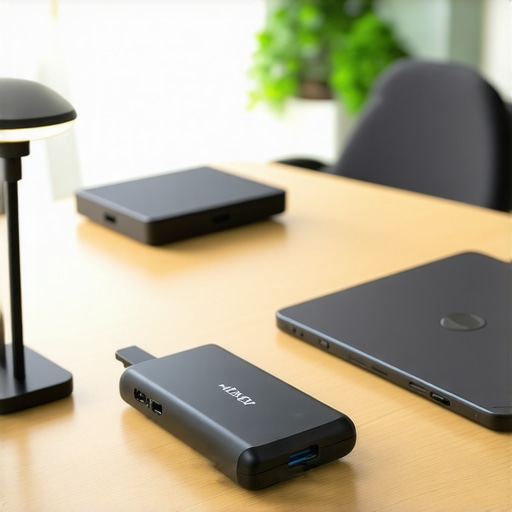
I used to think that professionalizing our space meant I could stop worrying about the small stuff, but the reality is that the hidden drag of slow office wi-fi on your burn rate is a monster that follows you wherever you go. To combat the inevitable tech friction, I developed what I call my ‘War Room Kit.’ I don’t go into any high-stakes meeting without a Satechi 10-in-1 USB-C Hub. Why this specific one? Because the problem with bring your own device in shared meeting rooms usually boils down to a single missing HDMI or Ethernet port, and this hub is the only one I’ve found that doesn’t overheat during a three-hour screen share. If you aren’t prepared for why a basic warranty wont save your startup from a hardware disaster, you’re just one broken dongle away from a failed pitch.
My go-to bag of tricks for zero-fail meetings
Beyond the adapters, I’ve become obsessed with visual presence. We realized early on that the lighting trick that makes your product demo look expensive isn’t about overhead lights—it’s about portable LED panels. I carry a small Lume Cube in my laptop bag. It’s the difference between looking like a founder in a basement and a professional leading a movement. When you stop letting bad lighting ruin your video calls, you noticed people stop squinting at their screens and start actually listening to your numbers. We also learned the acoustics test every conference room should pass: the ‘Snap Test.’ If you snap your fingers and hear a sharp ring, that room is going to butcher your audio. I always look for innovative meeting rooms that boost startup creativity that include heavy curtains or felt panels to dampen that echo.
How do I maintain a high-performance culture in a space I don’t own?
The biggest challenge isn’t the furniture; it’s the people. As we moved from the garage to a hub, I worried about what happens to your culture when you move to a private suite. We had to be intentional. We started by why our private office suites stock extra surface pro chargers for members, turning a simple convenience into a cultural value of ‘preparedness.’ We also made it a point to unlock networking opportunities in top coworking environments by hosting a monthly ‘demo day’ for other founders in the building. This keeps our team sharp and prevents the ‘silo’ effect that happens when you lock yourself behind a glass door for too long. According to the 2024 Jabra Hybrid Ways of Working Report, 80% of employees say that high-quality audio is the most critical factor for productive hybrid meetings, so we invested in a dedicated Jabra Speak 750 for our mobile office kit. This ensures that even in a ‘war room’ that isn’t ours, we sound like the smartest people in the room.
The future of the office is invisible
Looking ahead, I predict we are moving toward ‘Ambient Intelligence’ in workspaces. Imagine a room that automatically adjusts the how to find a conference room that actually has working adapters status to your phone as you walk in, or acoustics that digitally cancel out the person shouting in the communal kitchen next door. The next five years will be about software-defined spaces where the physical walls matter less than the digital layer on top of them. If you want to see an immediate jump in your team’s output, I challenge you to try this: for your next high-stakes call, how to vet a meeting room for acoustic privacy before booking and bring a dedicated external microphone. The clarity of your voice will command a level of authority that no PowerPoint deck ever could.
The Breakthroughs We Almost Missed While Playing House
I used to think the garage was a badge of honor, a sign of our gritty determination. In reality, it was a ceiling on our collective ambition. Once we made the move that helped us scale from 3 to 15 people in six months, the biggest lesson I learned was that professional gravity is a real force. You attract the level of talent and investment that matches your environment. When we were in the garage, we recruited ‘tinkers’; when we moved to a professional hub, we started attracting ‘builders.’
Another hard-won insight: don’t underestimate the power of a legitimate mailbox. Learning how to get a premium business address without the five-figure lease changed how vendors and banks treated us overnight. We stopped being ‘the guys in the garage’ and started being a credible entity in the eyes of the people who held the keys to our growth. #IMAGE_PLACEHOLDER_FINAL#
The Gear That Kept Us Professional Under Pressure
If you’re moving into flex spaces, you have to become your own mobile IT department to survive the transition. Beyond the Satechi hub I mentioned earlier, we quickly realized why ergonomic furniture is the best investment for your seed round—your developers can’t solve complex problems if they’re battling back pain from old kitchen chairs. Your health is a line item on your burn rate, even if you don’t see it yet.
For the sake of your next big presentation, always remember why your conference room needs better technology and fewer cables. A single tangled nest of wires or a flickering adapter can derail the most confident pitch you’ve ever given, making you look like an amateur even if your data is world-class. Invest in a reliable ‘go-bag’ of adapters and never trust a room you haven’t tested personally.
Your Vision Deserves Better Than a Concrete Floor
You aren’t just buying a desk or a few hours in a meeting room; you’re buying a psychological upgrade for yourself and your team. The transition from a startup ‘vibe’ to a scaling business is often uncomfortable, but staying stagnant in a space you’ve outgrown is far more dangerous. When you finally decide to master startup success secrets choosing the perfect conference room, you’ll look back at the garage days and wonder how you ever managed to build anything at all. Your vision is too big to be confined by a two-car door.
What’s the one thing holding you back from booking your first real war room and taking the leap? Let me know in the comments below!