

I was sitting in a glass-walled conference room that cost me $150 an hour, sweating through my button-down while an investor looked bored. The air was stale, the fancy coffee machine was broken, and the silence felt heavy enough to choke my pitch. We walked out of there with a polite “maybe” and a lot of wasted cash. Ten minutes later, while I was stress-eating a bagel in the communal kitchen, I ran into another founder. We started complaining about the Wi-Fi, swapped stories about failed pivots, and by the time my bagel was toasted, I had a lead on a new lead developer and a scheduled follow-up with a seed-stage VC. That was the day I realized the traditional boardroom is dead. [image_placeholder_1]
Forget the Mahogany Table and the Stale Air
I made a massive mistake early on by thinking a “real” business required a mahogany table and those ergonomic chairs that look like they belong in a spaceship. I even obsessed over why ergonomic furniture is the best investment before we even had a product-market fit. It was a total waste of capital. What I didn’t realize is that the stiff formality of a traditional meeting room often kills the very thing startups need most: raw, unscripted honesty. When you are standing in a shared kitchen, the hierarchy vanishes. You aren’t a CEO pitching a Director; you are just two people trying to figure out how the espresso machine works. This is precisely why the best business deals happen in the hallway rather than behind a closed door.
Is the kitchen table actually professional enough for a high-stakes deal?
You might worry that meeting a potential partner near a stack of someone else’s lunch containers is a bad look. But honestly, the modern investor landscape has shifted. Why investors prefer meeting in a high-energy hub often boils down to the sheer energy of the environment. According to a study published by the Harvard Business Review, face-to-face interactions—specifically the informal, unplanned kind—are the single most important predictor of a team’s long-term productivity and creative output. The kitchen isn’t just for snacks; it is a high-velocity networking machine where you can find your next CTO just by being present. Have you ever felt that your best ideas came to you while waiting for the microwave rather than during a scheduled brainstorm? I’d love to hear if your biggest “aha!” moment happened in a boardroom or a breakroom. Today, I want to show you how to stop hiding in your private suite and start treating the communal area like the strategic asset it really is.
Stop Overpaying for Square Footage You Never Use
To make the transition from a traditional office to a high-velocity coworking environment, you first need to stop treating office space like a status symbol. I remember spending three months paying for an eight-person suite when my team was just me and a part-time designer. We looked like two peas rattling around in a tin can. It killed our energy. Before you sign anything, conduct the 10-minute audit to see if your office space is wasting money. If your conference room sits empty 80% of the week, you aren’t being professional; you are being wasteful. In a shared ecosystem, you only pay for the boardroom when you actually have a board to meet. This shift in mindset allows you to redirect that saved capital into product development or better hardware.
Apply the Two-Pizza Rule to Every Booking
Amazon’s Jeff Bezos famously said if you can’t feed a team with two pizzas, the team is too big. The same logic applies to your workspace. Booking a 20-person auditorium for a three-person sync is a psychological disaster. It makes your startup feel small and insignificant. Instead, learn the two-pizza rule for booking the right size meeting room. A smaller, tighter space creates a pressure-cooker effect for ideas. I once closed a crucial partnership in a room barely larger than a walk-in closet. The proximity forced us to focus on the laptop screen together, creating a sense of shared mission that a massive mahogany table would have diluted. 
Run a 60-Second Tech Audit Before the Client Arrives
Nothing kills a high-stakes vibe faster than fumbling with a Dongle for ten minutes. I once sat through a pitch where the founder couldn’t get his deck to show up on the monitor, and the silence was deafening. You must know how to find a conference room that actually has working adapters before you invite an investor. Don’t take the community manager’s word for it. Walk into the room, plug in your own machine, and test the audio. You should also perform the acoustics test every conference room should pass by clapping your hands or taking a quick voice memo to check for echoes. If the room sounds like a hollow cavern, your pitch will sound thin and unconvincing.
Turn Your Laptop Charger Into a Networking Magnet
The communal areas aren’t just for coffee; they are for tactical positioning. If you sit in the far corner of the lounge with your back to the room, you are invisible. I started sitting near the busiest power strips and soon realized why your laptop charger is the best networking tool you own. Someone will eventually ask to share the plug, and that is your five-second window to ask what they are building. This isn’t about being a nuisance; it’s about the subtle art of networking at the communal office printer. I found our lead engineer because we both got frustrated by a paper jam at 6:00 PM on a Tuesday. We bonded over the broken hardware, and three months later, he was on our payroll. This is exactly why shared kitchens are the best place to find your next CTO; you see how people solve small problems before you trust them with the big ones.Most founders think the glass fishbowl is the gold standard for modern meetings. It looks cool, it feels transparent, and it is usually the most expensive room in the coworking hub. But here is the contrarian truth: glass walls are often the worst place to close a sensitive deal. In my experience, they create a theatre effect where everyone is performing for the people walking by instead of focusing on the work. This is not just my opinion. A study by the MIT Human Dynamics Lab found that physical barriers—specifically those that offer actual visual and acoustic privacy—can actually increase the quality of collaboration because people feel safer sharing half-formed, risky ideas. When you are in a glass box, you are subconsciously checking your posture. To avoid this, you need to learn how to vet a meeting room for acoustic privacy before booking. If people can see your lips moving from the hallway, they can probably hear your revenue projections too.
How Do I Protect Confidential Strategy in a Shared Space?
The oops factor most people miss is what I call the Acoustic Leakage Trap. You book a room, close the door, and assume you are in a vault. But many modern flex-spaces use thin partitions that stop at the drop-ceiling. Your secret pivot is now being broadcast to the freelance graphic designer in the next pod. Beyond just closing the door, you should check the acoustics hack for crystal-clear client pitches to ensure your voice stays where it belongs.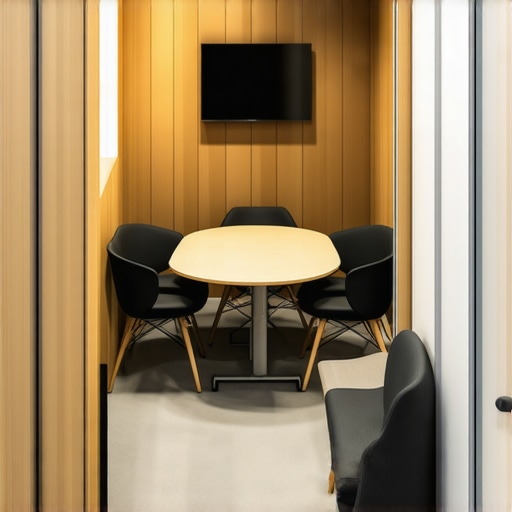 Also, pay attention to the environment physical psychology. Have you noticed you feel more stuck in certain rooms? It might be the architecture. Research suggests why your team is more creative in a room with high ceilings—it literally encourages more expansive thinking. Meanwhile, low-ceiling, windowless rooms are better for detail-oriented tasks like debugging or contract reviews. Don’t just learn how to pick a meeting room that doesn’t smell like old carpet; pick one that matches the cognitive load of your task. Finally, stop fighting the crowd. Everyone tries to book the hero room at 10:00 AM on a Tuesday. By 3:00 PM on a Friday, the place is a ghost town. If you know the secret to finding a meeting room on a Friday afternoon, you can treat your team to the best space in the building for the price of a standard desk. Have you ever fallen into the glass box trap and realized halfway through a meeting that everyone in the lobby was watching you fail at a whiteboard drawing? Let me know in the comments.
The Gear That Keeps My Pitch From Crashing
I’ve learned the hard way that you can’t rely on a coworking space’s default setup if you want to look like a Series A company. I now carry a ‘survival kit’ in my backpack because the hidden drag of slow office wi-fi on your burn rate is real, and it usually strikes right when you’re screen-sharing. I personally use a portable Wi-Fi 6 router to bridge the gap if the building’s infrastructure is ancient. Why? Because according to technical documentation from the IEEE 802.11ax standard, maintaining high-frequency throughput in dense environments (like a hub with 200 people) is impossible without dedicated spatial streams. If I’m doing a remote pitch, I also bring a small, clip-on LED panel. You need to stop letting bad lighting ruin your video calls, especially since most meeting rooms use overhead fluorescents that make you look like a ghost. I’ve even seen members struggle so much with basic power that why our private office suites stock extra surface pro chargers for members became a genuine selling point for the hub I use. It’s about being redundant; if the room fails, you shouldn’t.
How do I maintain a professional edge as the team scales?
As we grew, the ‘grab a coffee’ strategy started to fail. When you have five employees, you can’t all huddle around a single laptop in the kitchen without looking like a college project. This is the move that helped us scale from 3 to 15 people in six months: we shifted to a ‘hub and spoke’ model. We kept the flexible hot-desks for the junior staff to keep them socialized, but I invested in a dedicated four-person suite for the leadership. You have to decide if the move to a dedicated desk is the extra cost worth it based on how much deep-work privacy you actually need. For us, the privacy was the only way to how to host a webinar without background noise or connection drops during our first major product launch. Research from the Acoustic Society of America suggests that ambient noise above 55 decibels in open offices can reduce complex task performance by up to 10%, so as your tasks get harder, your room needs to get quieter. 
Why I Predict AI-Driven Sound Bubbles are Coming
Looking ahead, the era of the ‘dumb’ glass box is ending. I’m already seeing beta versions of the future of conference rooms in startup ecosystems where AI-driven beamforming microphones create a virtual ‘sound bubble’ around the speakers, effectively muting the rest of the coworking floor without needing thick walls. We are moving toward a world where your physical location matters less than the digital shield you carry with you. My advice? Don’t wait for the technology to catch up. Start treating your meeting environment as a piece of your product’s user experience today. I challenge you to try this: the next time you have a high-stakes call, book the room 15 minutes early and run a full audio-visual dry run. If you find one tech glitch before the client sees it, this whole article just paid for itself.
Lessons from the Trenches: What I Learned After 100 Meetings
The biggest realization I had was that a room is just a tool, not a savior. You can have the most expensive setup in the building, but if you haven’t mastered how to keep your startups trade secrets safe, you are vulnerable. I used to think I needed a soundproof bunker for every sensitive talk. Now I know that a consistent level of background hum can actually be an asset, acting as natural white noise that prevents eavesdropping. Also, never underestimate the power of the ‘pre-meeting walk.’ The thirty seconds you spend walking an investor from the lobby to the room is where you establish your status. If you are fumbling with a keycard or looking lost, you have already signaled that you aren’t in control of your environment. Finally, remember that why your pitch deck wont save you from a noisy meeting space is a lesson in environment over content; if they can’t focus on your voice, they won’t remember your vision.
Tools That Saved My Sanity and My Seed Round
If you want to stay ahead of the curve, you need to look at the future of conference rooms and adapt your workflow today. I never go into a high-stakes call without a backup plan for the internet, but I also rely on a few startup success secrets like booking the ‘hero room’ for only the first 30 minutes of a pitch to create a psychological sense of urgency. I also recommend checking out how the most innovative teams are transforming meeting rooms into collaboration hubs by ditching the table entirely and using standing-height whiteboards. These shifts in physical perspective are what actually drive creative breakthroughs when your team is hitting a wall.
The Next Great Idea is Waiting for You Near the Espresso Machine
Don’t wait until you have a twenty-year corporate lease to behave like a world-class company. The most successful founders I know are the ones who learned how to maximize productivity in your startups conference rooms while they were still sharing a desk with three other strangers. Your environment is a strategic lever—stop viewing it as a utility and start treating it as a piece of your product’s user experience. Whether it is a quick ten-minute sync or a four-hour board marathon, choose your meeting rooms with intention and let the energy of the hub propel you forward. Have you ever had a major deal fall through because of a tech glitch in a shared space, or did the energy of a busy lobby actually help you close? Let me know in the comments below!