
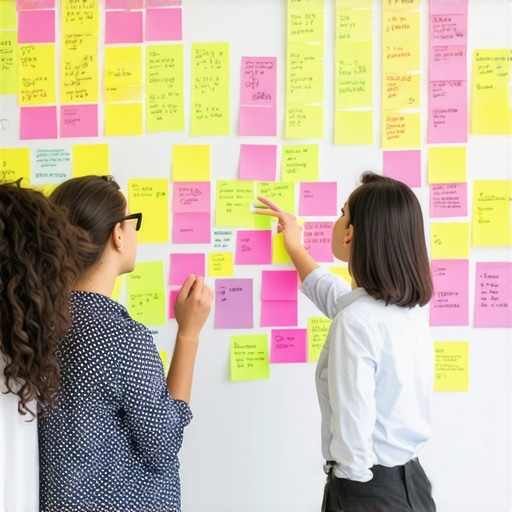
I will never forget the Tuesday we lost a quarter-million-dollar idea simply because we didn’t have a place to write it down. We were crammed into one of those sleek innovative meeting rooms, everyone tapping away on iPads and sharing digital whiteboards that lagged every time someone drew a circle. We thought we were being high-tech and efficient. In reality, we were just being distracted by the tools meant to help us. By the time the meeting ended, the most brilliant insight—a workflow hack our lead developer whispered during a heated debate—was buried under forty-five Slack notifications and never made it into the ‘final’ document. I made the classic mistake of thinking digital tools could replace the raw, messy energy of a physical space. Today, I am going to show you why ditching the screen for a dedicated wall will save your team’s sanity and why you need to set one up before this week is over.
Your Digital Tools Are Actually Killing Your Best Ideas
I used to be a total tech snob. I would argue that if it was not synced to the cloud, it did not exist. But here is the cold, hard truth: your brain processes information differently when you are standing up and looking at a six-foot-wide problem. When we rely solely on screens, we fall victim to the real reason your team is suffering from zoom fatigue—our peripheral vision is cut off, and our creative scope shrinks along with it. A study by researchers at the University of Tokyo found that writing on physical paper or a wall leads to significantly more brain activity and better memory recall than using digital tablets. It is not just an old-school preference; it is a biological advantage. If your office feels stagnant, it is likely because boring office furniture is draining your teams creative energy. You need a space where ideas can breathe, overlap, and stay visible long after the laptop lids are closed. Have you ever walked out of a high-energy meeting only to realize ten minutes later that nobody actually captured the breakthrough moment?
Is a Giant Wall Just a Messy Distraction?
You might be worried that a dedicated wall will just turn into a chaotic eyesore of half-baked thoughts and coffee-stained sticky notes. I thought the exact same thing during my first year running a team. In my first startup, I actually banned ‘unorganized sketching’ because I wanted everything to look professional and ‘clean’ for potential investors. That was a huge mistake that led to our most sterile, uninspired quarter on record. That ‘mess’ you fear is actually the physical map of your team’s collective intelligence. When you give your team a permanent, physical canvas, you are giving them permission to think in public. We are going to break down how to transition from digital-only to a hybrid approach that actually sticks.
Build Your Analog Brain on the Nearest Wall
Stop looking for a perfect, factory-made whiteboard. Most of the time, the best ideas are born on the glass partitions of innovative meeting rooms or even the back of a door. The goal isn’t to be pretty; it is to be visible. When you are scouting for your brainstorming HQ, don’t settle for a tiny corner. You need a space that matches the scale of your ambition. I have noticed that why your team is more creative in a room with high ceilings is not just about the air—it is about the psychological permission to expand your thoughts upward and outward. If you are stuck in a windowless box, your ideas will feel boxed in too.
Grab a Space That Lets You Think Big
In our early days, I wasted hours trying to find a conference room that actually has working adapters for our fancy digital dashboard. We spent forty minutes debugging a HDMI cable while our best developer’s inspiration slowly died. Now, I just hand everyone a chisel-tip marker. We once took over an entire glass-walled suite with blue painter’s tape because we ran out of board space. We mapped a three-month product roadmap across twelve feet of glass. People walking by thought we were crazy, but that was the only month we hit every single release deadline. The visibility was the accountability.
#IMAGE_PLACE_HOLDER_B#
Ditch the Digital Folders for Physical Zones
A wall only works if it has a logic that everyone understands at a glance. Divide your surface into three vertical columns. The first is “The Chaos”—this is where every raw, unvetted thought goes. No judgment, just data points. The middle is “The Filter,” where you ruthlessly kill ideas that don’t serve the core mission. This is exactly why we stopped using zoom for internal feedback loops; you can’t point at a screen and feel the weight of a bad idea like you can when you are physically ripping a sticky note off a wall. The final zone is “The North Star,” the one or two non-negotiable tasks for the week. If it is on the wall, it is the law.
Keep the Team Small Enough to Fit
Don’t invite the whole department. If you have twenty people staring at a wall, it becomes a spectator sport, not a strategy session. You need to follow the two-pizza rule for booking the right size meeting room. If you can’t feed the brainstorming group with two pizzas, the wall will become too cluttered to be useful. When we scaled from three to ten people, the “wall noise” almost broke our workflow. We had to implement a rule: if you didn’t contribute a physical note to the “Chaos” zone, you didn’t get a vote in the “Filter” zone. It forces active participation over passive observation.
The Prestige Trap Often Kills Creative Flow
Everyone tells you that a professional workspace needs to look like a scene from a high-budget tech documentary. We are led to believe that the more chrome and glass we have, the more ‘innovative’ we are. In my experience, this is the biggest lie in the startup world. I call it the Prestige Tax. When you spend thousands on a space that is too ‘precious’ to mess up, your team stops taking risks. They stop sticking things to the walls, they stop sketching on the windows, and they start acting like guests in their own office. You need to learn how to choose the perfect conference room for business success based on utility, not just aesthetics. A room that feels like a laboratory is always more productive than one that feels like a museum.
Why Do ‘Perfect’ Meeting Rooms Make Us Less Creative?
It sounds counterintuitive, but the ‘cleaner’ a room looks, the more it can stifle honest feedback. Environmental psychologist Robert Sommer famously discussed the concept of ‘hard’ and ‘soft’ architecture. ‘Hard’ environments—think fixed furniture, glass walls, and non-adjustable lighting—actually discourage participation because people feel they cannot influence their surroundings. Conversely, ‘soft’ environments allow for the messy, adaptive energy that startups thrive on. This is exactly why the checklist for a boardroom that doesnt feel like a hospital is so important. If your team feels like they might leave a smudge on a pristine surface, they will hold back their most radical ideas. Have you ever fallen into the trap of booking a room just because it looked cool on the website, only to realize nobody felt comfortable actually working in it? Let me know in the comments.
#IMAGE_PLACE_HOLDER_C#
The Hidden Nuance of High-Energy Hubs
There is a massive difference between a ‘quiet’ room and a ‘productive’ one. Most founders think they need absolute silence for a strategy session. That is a mistake. Silence often leads to overthinking and a lack of momentum. There is a specific reason why investors prefer meeting in a high energy hub over a quiet cafe; the background hum of activity creates a sense of urgency and progress. When you are isolated in a soundproof box, the stakes feel artificially high, which can lead to ‘analysis paralysis.’ The trick is to find a space that offers acoustic privacy without social isolation. We discovered the truth about productivity in a room full of total strangers is that it actually forces you to stay on task because you feel the collective weight of everyone else’s work ethic.
How Do You Balance Professionalism with Productive Mess?
The mistake most people make is thinking these two things are mutually exclusive. You can have a high-stakes meeting in a room that is clearly being ‘used.’ In fact, showing a potential hire or an investor your ‘Chaos Zone’ on the wall shows them that you are actually doing the work, not just preparing to do it. It proves that your strategy is alive. If you are worried about appearances, remember that the cost of a bad first impression why your home office is a liability isn’t about having the fanciest desk—it is about having a space that reflects a functional, high-output culture. Don’t be afraid of the markers and the tape. Be afraid of a wall that is perfectly blank.
Keep the Momentum Alive Through a Friday Purge
It is one thing to build a wall; it is another to keep it from becoming a graveyard of dead ideas. I have seen too many innovation walls turn into dust-covered archives of the first week’s enthusiasm. To prevent this, I use a Friday Purge protocol. Every Friday at 2:00 PM, we ruthlessly clear anything that hasn’t been moved or referenced in the last seventy-two hours. If it is truly vital, it earns a spot in our digital archive; if not, it hits the recycling bin. This is how to maximize productivity in your startups conference rooms by 0245 pm—you have to clear the decks before the weekend starts. For tools, I do not just buy generic markers. I swear by the Neuland No.One refillable markers. They are wedge-tipped, designed for visual facilitators, and do not smell like industrial chemicals. For the sticky notes, use the Super Sticky variety or do not bother; regular ones will fall off the glass by morning and your multi-million dollar pivot will end up stuck to the bottom of a sneaker.
How do I maintain this creative system as we scale?
As your team expands, your physical space needs to adapt. This was the move that helped us scale from 3 to 15 people in six months—we transitioned from one shared wall to individual squad zones. When you have too many cooks in one kitchen, the signal-to-noise ratio collapses. I follow the methodology laid out by productivity expert Tiago Forte in his book Building a Second Brain, specifically the CODE framework (Capture, Organize, Distill, Express), but adapted for physical environments. We capture on the wall, but we distill into our project management software. This hybrid approach is the future of conference rooms in startup ecosystems. We are moving toward smart surfaces that can instantly digitize a physical sketch without losing the tactile feel.
#IMAGE_PLACE_HOLDER_D#
What the Future Holds for Our Physical Spaces
In the next few years, I predict we will see persistent AR where you can point your phone at a blank office wall and see the digital layers of the previous day’s brainstorming session still hanging there. It is the ultimate way to utilize innovative meeting rooms that boost startup creativity without the permanent clutter. My best tip for you today? Assign a Wall Guardian. This is not a janitorial role; it is a strategic one. This person ensures that the North Star zone is updated every Monday morning. Give it a try for one month—pick one person to own the wall’s integrity. You will find that startup success secrets choosing the perfect conference room at 0817 am are often found in the small habits of organization, not just the architectural choices.
Hard Truths About Managing the Chaos of a Creative Wall
Over the years, I have realized that the wall is not a storage unit; it is a live engine. If a sticky note stays in the same spot for more than three days, it has already lost its power. I once thought that the most organized person should lead the brainstorming, but I was wrong. The best walls are managed by the person most comfortable with mess, because they aren’t afraid to move things around. I also learned that creative coworking transforming meeting rooms into collaboration hubs at 0455 pm only works if the environment feels temporary and fluid. If you make your wall look like a finished art project, people will be too intimidated to add the raw, ugly insights that actually lead to breakthroughs. Finally, the physical act of standing up changes the chemistry of the room. When people sit, they defend their territory; when they stand at a wall, they collaborate on a shared vision.
The Brainstorming Kit That Actually Lives in My Bag
I don’t leave my productivity to chance, and I certainly don’t rely on whatever supplies are left over in a shared drawer. My personal toolkit starts with Post-it Super Sticky Notes—specifically the 4×4 size, which gives you enough room to draw a diagram rather than just a word. I also recommend checking out the coworking spaces unlock innovation top meeting rooms of 2025 at 1123 am list to find locations that prioritize glass and whiteboard surfaces. For books, The Art of Noticing by Rob Walker is my go-to for breaking out of cognitive ruts. It’s not a business book, but it will teach your team how to see the details that everyone else is missing. Lastly, I always keep a digital camera or a high-quality scanning app ready; the wall is for thinking, but the cloud is for remembering.
Build Your First Innovation Wall This Afternoon
The biggest mistake you can make is waiting for a formal meeting or a ‘perfect’ office setup to begin. You can start with a roll of butcher paper and a piece of masking tape. The goal is to create a space where your team feels the psychological safety to be ‘loud’ with their ideas. Whether you are working out of a garage or scouting innovative meeting rooms that boost startup creativity, the principle remains the same: visibility is the ultimate catalyst for momentum. When you see your progress mapped out in six-foot-wide strokes, the obstacles start to look a lot smaller. It’s time to stop talking about your ideas and start looking at them. You might even unlock networking opportunities in top coworking environments just by having the most interesting wall in the building. Have you ever had a brilliant idea during a meeting only to realize five minutes later that no one actually wrote it down? Let me know in the comments.