

I remember sitting in a windowless incubator room three years ago, staring at an acoustic tile ceiling that felt like it was inches from my forehead. My team and I were trying to pivot our entire product strategy, but every session ended in a pointless debate about font sizes or color palettes. We couldn’t see the big picture because we literally couldn’t see past the cramped walls. I thought I was just burnt out, but the truth was much simpler: I was stuck in a box. It wasn’t until we made the move from a garage to a flex office that I realized how much the physical volume of a room dictates the volume of your ambition. If you’ve ever felt like your thoughts were hitting a literal wall, you aren’t imagining things. Today, I’m going to show you how high ceilings unlock a specific type of cognitive processing that can save your startup from small-mindedness.
Your Brain Actually Expands When the Ceiling Goes Up
Early in my career, I made the classic mistake of thinking a desk was just a desk, regardless of where it sat. I chose a basement unit because it was cheap, thinking I was being ‘scrappy.’ Instead, I was just strangling our creativity. Science calls this the Cathedral Effect. A landmark study by Joan Meyers-Levy at the University of Minnesota found that when people are in rooms with high ceilings, they are significantly more likely to engage in abstract, relational thinking. They see connections between disparate ideas. In contrast, low ceilings trigger concrete, detail-oriented processing. That is why why your team is more creative in a room with high ceilings; the space literally gives your neurons permission to roam. If you are trying to solve a complex architectural problem or a brand-new market strategy, doing it in a room with eight-foot ceilings is like trying to run a marathon in a hallway.
Is a Fancy High Ceiling Just a Waste of Your Seed Round?
You might be thinking that paying extra for ‘air’ is the kind of startup vanity that leads to a high burn rate. I get it. I used to be the person who scoffed at high-end spaces until I realized that ditching the basement was actually an investment in our output quality. When we switched to innovative meeting rooms with industrial-height ceilings, our strategy sessions went from bickering over ‘how’ to dreaming about ‘what if.’ Have you ever noticed your best ideas come to you when you’re outside or in a grand hall? Tell me about the most ‘boxed-in’ you’ve ever felt in an office—I bet the ceiling height had something to do with it.
Match Your Thinking Style to the Room Volume
To move from a cramped basement mindset to a growth-oriented strategy, you need to treat your workspace like a cognitive tool, not just a line item in your budget. If you are crunching numbers or fixing bugs, a lower ceiling can actually help you focus on the minutiae. However, for big-picture brainstorming, you need to seek out volume. When I was prepping for our first major investor pitch, we spent three days locked in a standard 8-foot-ceiling office. We were arguing about the font on slide twelve. I finally realized we were literally ‘thinking small.’ We moved the session to one of the innovative meeting rooms with twenty-foot industrial rafters. Within an hour, we stopped talking about fonts and started talking about our ten-year ecosystem play. The physical space forced us to look up, and our thoughts followed.
Reserve High Ceilings for Strategy and Low Ones for Execution
Don’t just book any available space; audit the room’s architecture against your meeting’s goal. If your objective is a ‘blue-sky’ session where no idea is too crazy, you need a room that feels like a gallery. This is where maximizing productivity in your startups conference rooms becomes a matter of physics. If you are doing a deep-dive technical audit or a legal review, stay in the smaller, more ‘contained’ spaces to keep the team from drifting. 
The 10-Minute Audit Before You Sign the Booking
Before you commit to a long session, you need to verify the vibe. Most founders just look at the table size, but you should be looking at the ‘air.’ When you enter, do you feel an immediate sense of relief or a slight pressure in your chest? That is your nervous system reacting to the room’s volume. I have learned to always vet a meeting room for acoustic privacy and height before a board meeting. If the room is high but echoes like a canyon, your message will get lost. You want a space that feels expansive but still retains a sense of focus.
Why the Two-Pizza Rule Still Applies to Large Spaces
Even when you are hunting for height, don’t over-scale the floor plan. If you put four people in a room designed for forty, you lose the collaborative spark. The two-pizza rule for booking the right size meeting room ensures that while the ceiling is high, the team remains close enough to read each other’s body language. It is about creating a ‘cathedral of thought’ where the energy stays focused on the whiteboards rather than dissipating into the corners of a giant, empty hall. This balance is exactly how to choose the perfect conference room for business success; it’s about finding the sweet spot between vertical freedom and horizontal intimacy.Most founders think that ‘professional’ means a glass-walled aquarium with a heavy oak table. They spend half their seed round on a premium address only to find their team feels like they are being watched in a fishbowl. Everyone says you need a sterile, quiet environment to close a deal, but in my experience, investors prefer meeting in a high energy hub where they can feel the kinetic energy of a growing company. If the room feels too corporate, it triggers a defensive posture. You want your team and your investors to feel like they are part of a movement, not a deposition.
Stop Overpaying for Corporate Polish
The biggest trap I see is the ‘Premium Aesthetic’ fallacy. You walk into a space that looks like a law firm from the 90s, thinking it adds gravitas. In reality, boring office furniture is draining your teams creative energy by signaling that compliance is more important than innovation. I once spent three thousand dollars on a day-rate for a ‘VIP’ suite that had zero natural light and a Wi-Fi connection that lagged every time someone used the microwave. I was paying for the marble in the lobby, not the productivity in the room. This is why a quick 10-minute audit to see if your office space is wasting money is non-negotiable. If you are paying for mahogany but getting 10Mbps upload speeds, you are failing the basic hygiene of modern business. 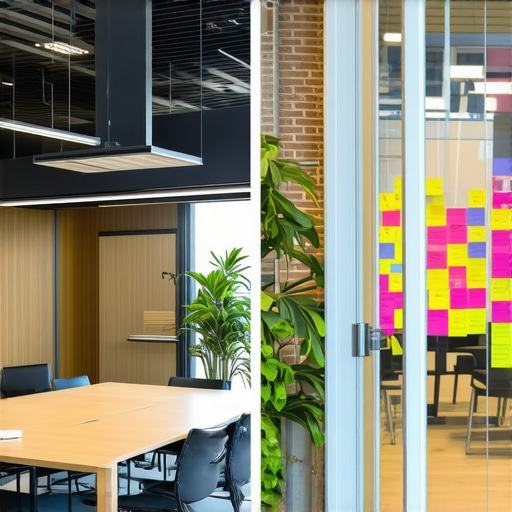
Can a room be too large for a small team’s big vision?
There is a psychological nuance to space called ‘Proxemics,’ a term coined by researcher Edward T. Hall. He argued that physical distance between people directly dictates the type of relationship and communication taking place. While high ceilings help with abstract thought, having too much horizontal space between team members can actually create a sense of isolation. If you book a thirty-person boardroom for a four-person brainstorming session, you’ll find that your ideas feel thin and unsupported. To counteract this, you must prioritize how to choose the perfect conference room for business success by matching the floor footprint to the team size, even while you keep the ceilings high.
Beware the Glass Wall Acoustic Shadow
Another common ‘oops’ factor is the architectural trade-off of glass. Modern coworking spaces love glass walls because they look ‘open.’ However, without proper acoustic treatment, these rooms become echo chambers. I’ve seen million-dollar pitches fall flat because the founder sounded like they were shouting from the bottom of a well. Always look for rooms with rugs, acoustic clouds, or fabric wall panels. You need the acoustics hack for crystal clear client pitches to ensure your voice carries authority, not just volume. Also, don’t get blinded by the tech. The more complex the integration, the higher the chance it breaks. I always prioritize how to find a conference room that actually has working adapters over one that promises ‘one-touch AI meeting integration’ that rarely works with a standard laptop. Have you ever fallen into the trap of booking a room that looked great in photos but was a nightmare in practice? Let me know in the comments.
Pack the Right Tech or Watch Your Meeting Die
I’ve learned the hard way that you can’t trust a booking description. I never walk into a high-stakes session without my own ‘battle kit.’ It’s the only way to ensure the secret to running a board meeting that stays on schedule isn’t derailed by a missing dongle or a dead battery. I specifically carry a high-end multi-port hub because how to find a conference room that actually has working adapters is a game of chance I’m no longer willing to play. For my developers, software tools like how Parallels Desktop saved our dev team from the two-laptop shuffle are non-negotiable for seamless demos in client-facing environments. We even had a situation where the data recovery move that saved a members pitch deck at the last minute only worked because we were in a space that prioritized high-speed physical hardware connections over purely aesthetic furniture. When you own your tech stack, the room becomes a secondary concern, allowing you to focus on the high-level strategy we discussed earlier.
How can I keep the culture from fading as we expand?
The biggest risk of success is the dilution of the energy that got you there. When we made the move that helped us scale from 3 to 15 people in six months, I was terrified we’d lose our edge. You have to be intentional about what happens to your culture when you move to a private suite. In a large room, the ‘silence’ can become heavy and isolating. I maintain our momentum by rotating our ‘high-ceiling’ brainstorming days with ‘heads-down’ execution days in smaller, more intimate pods. This keeps the team from burning out while ensuring we still hit those creative peaks that high-volume spaces provide. If you don’t actively manage the transition from a shared table to a private office, your ‘big office’ will quickly feel like a ghost town where innovative ideas go to die. #IMAGE_PLACE_HOLDER_D#
The Smart Office Isn’t Just About Fancy Sensors
Looking ahead, the future of conference rooms in startup ecosystems isn’t just about faster Wi-Fi or better coffee; it’s about ‘acoustic intelligence.’ We are moving toward spaces that can dynamically adjust their sound profile based on the number of people in the room. This isn’t just marketing fluff. If you look at the ISO 3382-3:2012 technical standard for acoustics in open-plan offices, it highlights the ‘distraction distance’ as a critical failure point for cognitive work. Future spaces will solve this with active noise-masking that allows a massive brainstorm and a deep-work coding session to happen ten feet apart without interference. Until that tech becomes standard, you have to be the architect of your own focus by maximizing productivity in your startups conference rooms through manual vetting. My best advice? Stop waiting for the perfect room to exist and start building your own portable environment. Go buy a high-quality universal adapter hub and a dedicated portable SSD today—it’s the cheapest way to upgrade any workspace instantly. If you need help vetting your next location, feel free to contact us for our internal checklist.
The Brutal Truth About Scaling Beyond the High Ceiling Phase
If I could go back and talk to my younger self in that windowless basement, I’d tell him that physical constraints are mental constraints in disguise. One major lesson I learned is that you can’t just buy your way into creativity by renting a big room; you have to actively design the culture to use that space. Many founders find startup success secrets choosing the perfect conference room at 08:17 AM aren’t just about the architecture, but about how the team interacts within it. Don’t let the grandeur of a space intimidate your team into silence. Instead, use the height to encourage the loudest, messiest versions of your ideas before you narrow them down in a more confined setting.
Tools That Keep My Headspace Clear regardless of Room Size
I’ve developed a toolkit of focus that I bring into every space, ensuring that even if I’m in a less-than-ideal environment, I’m not losing output. First, I always check if why ergonomic furniture is the best investment for your seed round is prioritized in the space; if the chairs are bad, the high ceilings won’t save your back or your focus. Second, I recommend the book A Pattern Language by Christopher Alexander; it’s the bible for understanding why certain spaces feel alive while others feel dead. Lastly, never underestimate a good set of noise-canceling headphones to create a virtual ceiling when you’re stuck in a low-volume environment.
Your Ambition Deserves a Room That Can Hold It
At the end of the day, your startup is a reflection of where you spend your time. If you continue to cram your vision into small, dark corners, don’t be surprised when your growth plateaus. You need to seek out coworking spaces that unlock innovation with top meeting rooms of 2025 to ensure your environment is working for you, not against you. Take the leap, audit your current space, and don’t be afraid to demand more air. Your next billion-dollar idea might just be floating ten feet above your head, waiting for you to look up. Have you ever walked into a room and instantly felt your brain fog lift just because of the architecture? Let me know below.