

I was standing there, sweat trickling down my neck, holding three different white plastic dongles like some kind of tech-obsessed wizard. My potential investor was tapping his pen on the mahogany table. We had forty minutes, and ten of them had already evaporated into the “Searching for Signal” abyss. It was embarrassing. It was unprofessional. And honestly? It was completely avoidable. That afternoon was the wake-up call I needed to realize that why your meeting room layout is killing participation often comes down to the physical mess cluttering the table. I realized that a room filled with tangled wires is a room where focus goes to die. Today, I want to share how I stripped back the chaos and built a setup that actually works, so you never have to scramble for a VGA adapter while your future is on the line.
Stop Letting Cables Kill Your Best Ideas
I used to be the guy who brought a literal suitcase of cords to every presentation. I thought being over-prepared meant having every possible connection point covered. It was a massive mistake. Early on, I spent a small fortune on “pro-grade” dongles that ended up failing at the worst possible moments. I learned the hard way that the checklist for a glitch-free product launch event or an investor pitch actually starts with subtraction, not addition. When you walk into a room and everything just connects wirelessly, the energy changes. You aren’t a technician; you’re a leader. A cluttered table leads to a cluttered mind, and how to deal with technical glitches shouldn’t be your main skill set. You need to focus on your vision, not the HDMI port. According to a study by Barco, the average meeting delay caused by technical setup issues is around 12 minutes—think about the thousands of dollars in lost productivity that represents for a growing startup.
Does fancy gear really make a difference for a tiny startup?
You might be thinking that your team is small enough to just huddle around a single laptop. I thought so too, until I saw the difference in engagement when we finally upgraded. It turns out that why your pitch deck looks better on a forty inch screen than a laptop isn’t just about the pixels; it’s about the shared experience. It signals to your team and your clients that you take your work seriously. Have you ever lost the room’s energy because a cable wouldn’t connect or a screen kept flickering? I’d love to hear your most cringeworthy technical failure stories in the comments below. Let’s look at how we can move past the wire-spaghetti and into a world where the tech just stays out of the way.I started by adopting a strict ‘wireless-first’ rule. If I can’t cast my screen in under fifteen seconds, the room isn’t ready. This isn’t just about vanity; it’s about maintaining the ‘flow state’ of a high-stakes conversation. I remember a demo in 2021 where I spilled half a latte across the main table. If I had been tethered to an HDMI cable, that laptop would have been toast and the meeting dead. Instead, because I was casting wirelessly from a side table, we just wiped the desk and kept talking. That’s why your meeting room needs to be more than just a table; it needs to be a fail-safe environment.
Kill the Dongle Habit Before it Kills Your Deal
The first step to a professional setup is moving away from physical connectors. Standardizing your team on a single wireless protocol—whether it is AirPlay, Chromecast, or a dedicated hardware system like ClickShare—eliminates the ‘which adapter do I need?’ dance. When you rely on wires, you are at the mercy of the physical integrity of a five-dollar piece of plastic. By going wireless, you free yourself to move around the room, which naturally increases your presence. If you are scouting new spaces, you must how to test the wi-fi speed before you book that venue because a wireless presentation is only as stable as the network it sits on. I once lost a connection mid-sentence because the coworking space had their router hidden behind a metal filing cabinet. Now, I always check for a dedicated presentation VLAN to ensure my screen doesn’t lag while I am explaining my revenue projections.
Why the Screen Size Dictates Your Authority
It is a psychological fact: people take your data more seriously when it is displayed on a scale that commands the room. We discovered that why your pitch deck looks better on a forty inch screen than a laptop is largely due to the shared focal point it creates. When everyone is squinting at a 13-inch MacBook, the energy is internal and quiet. When it is on a massive wall-mounted display, the energy is external and collaborative. 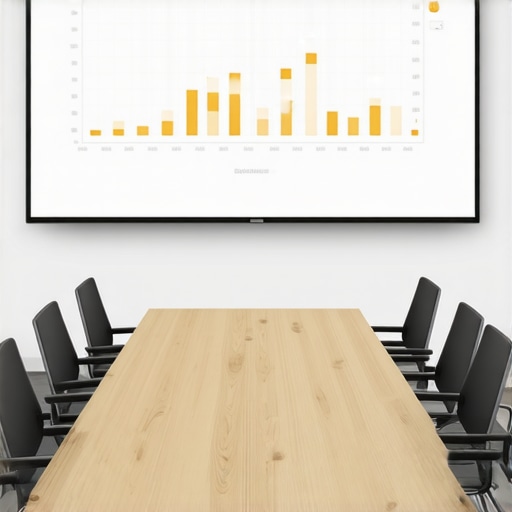
Fix the Echo Before Your Investors Tune Out
Audio is actually more important than video. If your video cuts out, you can still talk; if your audio is a garbled, echoey mess, the meeting is over. Most startup rooms are boxes made of glass and hard drywall, which are acoustic nightmares. You need to look for the acoustic fix for echoey conference rooms, such as felt panels or even just heavy curtains, to dampen the bounce. In my last office, we actually used a thick rug and some strategically placed bookshelves to stop the ‘cavern’ sound that was driving our remote board members crazy.
Perform a Five Minute Dry Run Every Single Time
You should never be ‘discovering’ a technical issue while a client is watching. I treat every major pitch like a Broadway opening. This means arriving early to follow the exact checklist for vetting a high-stakes board room. I check the sightlines from every chair, ensure the remote mic picks up a whisper from the back corner, and verify that the lighting doesn’t wash out the main display. This level of preparation is how to maximize productivity in your startups conference rooms by 0245 pm, ensuring that the afternoon’s most important tasks aren’t derailed by a firmware update or a dead remote battery. Control the environment, or the environment will control your reputation.
We have all been sold the same dream: sleek glass walls, open-concept floor plans, and the idea that ‘transparency’ equals innovation. But after five years of building teams in shared spaces, I have realized that the industry is obsessed with an aesthetic that is actually a productivity trap. Everyone says that open environments foster collaboration, but in my experience, the ‘fishbowl effect’ does the exact opposite. When you know everyone can see you, you stop taking risks. You stop having those raw, messy, and necessary debates. This is why your startup needs a real door, not just a glass wall, because privacy is the ultimate currency of deep work.
Stop Falling for the Fishbowl Aesthetic
The biggest mistake I see founders make is choosing a coworking space based on how it looks on Instagram. They see the floor-to-ceiling glass and think ‘modern,’ but they don’t consider the cognitive load of being on display. A Harvard Business Review study by Ethan Bernstein found that when employees transitioned to open, transparent offices, face-to-face interaction actually dropped by roughly 70% as people retreated into their headphones to find a sense of privacy. It is a massive irony: the more we remove physical barriers, the more psychological ones we build. This is a primary reason the truth about shared office noise levels isn’t just about decibels; it’s about the visual distraction of constant movement.
Is Your ‘Open Culture’ Actually Costing You Talent?
Your top engineers and designers don’t want to work in a zoo. They need ‘flow,’ and flow is fragile. I have seen brilliant developers walk away from high-equity roles because the office environment was a constant barrage of visual and auditory interruptions. When you are vetting a space, you need to know how to spot a toxic coworking vibe in under five minutes, and usually, it starts with a lack of dedicated quiet zones. If a space prioritizes the ‘vibe’ of the lounge over the functionality of the meeting rooms, run. You aren’t paying for a social club; you are paying for a launchpad. Have you ever fallen into this trap where you chose style over substance? Let me know in the comments.
Keep Your IP Behind Closed Doors
There is a dangerous nuance that most early-stage founders overlook: information security. In a glass-walled conference room, your sensitive pitch deck, your cap table, or your product roadmap is visible to anyone walking by with a smartphone. I have personally sat in a lounge and seen a competitor’s entire Q3 strategy displayed on a 60-inch screen because they didn’t understand how to keep your startups trade secrets in an open office. It’s an easy ‘oops’ factor that can have devastating consequences. If you are discussing anything sensitive, you need to understand the difference between a standard meeting room and a real war room. A real war room has solid walls, whiteboards that can be erased or covered, and zero line-of-sight from the hallway.

Beyond the visual security, there is the ‘echo’ of the startup world. Most people think a loud room is just annoying, but it is actually a signal of poor infrastructure. I always look for the acoustic fix for echoey conference rooms before I sign any agreement. If the management hasn’t invested in sound-dampening panels or high-quality seals on the doors, they are cutting corners that will eventually cost you a client or an investor’s confidence. High-stakes meetings require a sense of containment. You want the energy to stay in the room, not bleed out into the communal kitchen. Focus on the hidden nuances—the sound, the sightlines, and the security—and you’ll find that your team’s output skyrockets because they finally feel safe enough to actually work.
Maintenance isn’t just about wiping down the mahogany table or emptying the trash; it is about the invisible digital infrastructure that keeps your team from grinding to a halt. I have learned that as you grow, the ‘set it and forget it’ mentality is a death sentence for productivity. When we were first figuring out how to get the most out of a 24-7 access membership, I realized that the equipment in a shared space is only as good as the last person who used it. To scale successfully, you need to transition from a ‘user’ to a ‘manager’ of your environment, ensuring that your tools are always ready for the next pivot.
The Invisible Stack That Keeps My Team Sane
I personally rely on a specific hardware-software hybrid that most startups ignore until it is too late. For audio, I refuse to use the built-in laptop mics; we use the Jabra Speak 750 because of its full-duplex audio, which allows for natural, simultaneous conversations without that awkward ‘walkie-talkie’ clipping. On the software side, we use Robin for room scheduling. It prevents the double-booking wars that can ruin a Monday morning. This level of organization is essential when you are considering the role of flex space in a modern business scaling strategy 2. You cannot scale a culture on chaos; you need a predictable, repeatable process for every meeting, whether it is an internal stand-up or a final funding round.
Stop Blaming the Hardware and Fix the Network
Most of the technical glitches I see aren’t actually hardware failures—they are network congestion issues. According to the Wi-Fi Alliance’s technical specifications for Wi-Fi 6E, utilizing the 160 MHz channels in the 6 GHz band is the only way to avoid the ‘packet-collision’ nightmare that happens when twenty startups share the same hallway. If you are experiencing lag during a pitch, it is likely because your neighbors are all streaming 4K video on the same 2.4GHz band. This is a critical factor in how to stop your team from hating hybrid meetings. If the remote participants feel like they are watching a stop-motion film, they will check out in five minutes. I always insist on a hardwired Ethernet connection for our primary presentation hub to bypass the wireless ‘noise’ of the coworking lounge.
How Do I Keep This Setup From Breaking Next Week?
The secret to long-term success is the ‘Sunday Night Audit.’ Every week, I or one of my leads spends ten minutes checking three things: firmware updates, battery levels on wireless peripherals, and cable integrity. It sounds tedious, but it is the difference between a smooth demo and a public tech failure. As we look toward the future of conference rooms in startup ecosystems, I predict we will see more AI-driven ‘self-healing’ networks that automatically shift frequencies to avoid interference. Until then, you are the steward of your own tech. You also need to know how to manage noise complaints in a shared workspace by ensuring your own audio levels aren’t the ones causing the problem. My advice? Go to your router settings right now and check if you are using a DFS channel; it might be the reason your screen flickers every time a plane flies over the office. Control the variables you can, so you can focus on the variables you can’t—like your revenue targets.
What My Investors Noticed Before I Ever Opened My Mouth
After years of pitching in everything from broom closets to high-rise boardrooms, I realized that why investors prefer meeting in professional settings isn’t about snobbery; it’s about the subconscious signal of competence. One mentor told me that if a founder can’t manage a projector, they can’t manage a million-dollar seed round. It sounds harsh, but it is the reality of the high-stakes world. Another ‘lightbulb’ moment was realizing that innovative meeting rooms that boost startup creativity are rarely the ones with the most gadgets—they are the ones that allow for human connection without the friction of technical failure. I also learned to never trust a room that I haven’t physically walked through; you need to see the glare on the screen and hear the hum of the HVAC before you invite a high-value lead inside.
The Gear That Survives My Daily Grind
To keep our operations lean, we had to learn how we cut our office rent in half without losing talent, and part of that was investing in a portable tech stack rather than permanent office fixtures. I highly recommend a dedicated wireless presentation remote; it works on digital screens where traditional lasers fail and allows you to move freely. For scheduling, we swear by cloud-based management tools to avoid the ‘room poaching’ drama that plagues shared spaces. And honestly? My most trusted tool is a simple USB-C to Ethernet adapter. When the Wi-Fi gets crowded, being the only person with a stable connection is a superpower that ensures your demo never lags.
Build Your Own Stage for Success
At the end of the day, your environment is the silent partner in every deal you close. You don’t need a massive budget to create a professional atmosphere, but you do need intention. By taking the time to learn how to choose the perfect conference room for business success, you are giving your ideas the platform they deserve. Stop fighting with your equipment and start focusing on your vision. Your team, your investors, and your future self will thank you for it. Every great startup story has a scene where the founders finally move into a space that matches their ambition—make sure your conference room is ready when that moment comes. Have you ever had a high-stakes pitch derailed by a technical glitch or a noisy neighbor? I would love to hear how you handled it in the comments below!