
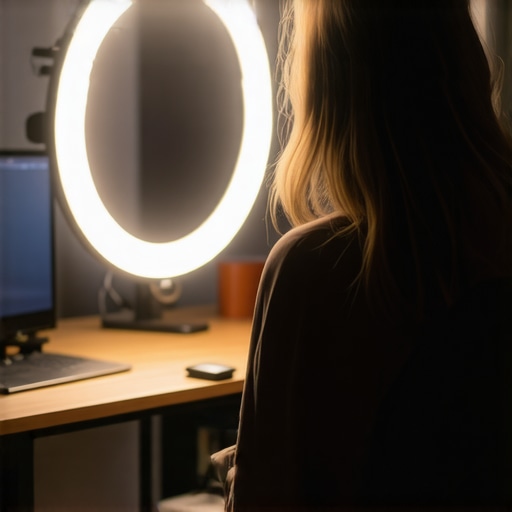
I will never forget the day I sat in a sleek, glass-walled conference room for the most important pitch of my life. I had the deck, the energy, and a product that I knew could change the market. But ten minutes in, the lead investor squinted at his screen and asked, “Are you sitting in a dark basement?” My heart sank. I wasn’t in a basement; I was in a premium coworking space, but the harsh overhead fluorecents were casting deep, raccoon-like shadows over my eyes. I looked less like a founder and more like a witness in a high-stakes crime documentary. That was my wake-up call: in our digital-first startup ecosystem, your lighting is your handshake. If people can’t see your eyes, they can’t see your vision.
Shadows Are Killing Your Professional Credibility
When I first made the move from garage to office, I mistakenly thought my only technical hurdles would be connectivity. I spent weeks worrying about whether home wi-fi failures would drop my calls, completely ignoring the visual presence I was projecting. I once spent an entire hour-long board meeting looking like a glowing orb because I sat directly in front of a floor-to-ceiling pane of glass. I thought I was being smart by picking the brightest spot in the building, but I had failed to vet the office space for natural light properly. The result was a grainy, overexposed mess where my face was just a silhouette against a blinding background.
The problem is that our brains are wired to trust what we can see clearly. Research published in the Journal of Psychological Science suggests that humans judge trustworthiness within 100 milliseconds of seeing a face, and poor lighting can accidentally signal hostility, fatigue, or even deceit. It is a harsh reality for any startup founder trying to close a deal. It’s often why your pitch failed in that noisy coffee shop or that poorly lit corner—your environment was screaming “amateur” while your words were saying “expert.” Today, we are going to fix that. I am going to share exactly how you can reclaim your screen presence without needing a Hollywood budget.
Do you really need to buy a Hollywood-style rig?
There is a common fear that to look professional, you need to turn your desk into a professional studio with three-point lighting and expensive softboxes. I fell into that trap early on, spending way too much money on gear that just cluttered my workspace. The truth is much simpler. Whether you are using innovative meeting rooms or your own desk, the key is understanding how light hits your face, not how much the lamp cost. We are going to dive into the exact lighting setup for professional video pitches that I finally mastered after years of looking like a ghost on camera. Have you ever caught a glimpse of yourself in the Zoom preview window thirty seconds before a call and realized the shadows made you look like you hadn’t slept in a week? You aren’t alone, and it’s time to stop letting your conference room’s architecture dictate your authority.
Stop the Silhouette by Facing the Source
The cardinal rule of video presence is simple: the light must be in front of you, not behind you. When you sit with a window at your back, your webcam’s auto-exposure panics. It sees the bright sky and crushes the shadows on your face to compensate, leaving you looking like a witness in a witness protection program. I learned this the hard way during a session in one of those innovative meeting rooms that boost startup creativity. I was so enamored with the city view that I sat facing away from the glass. The investor spent the first five minutes squinting before asking if my camera was broken. Now, I always rotate the desk or my chair so the natural light hits my face directly. If you are working late or in a windowless interior, position a desk lamp slightly behind your monitor so the glow washes over your features without causing a glare on your glasses.
Ditch the Laptop Lean and Elevate Your Authority
Most founders keep their laptop flat on the table. This forces the camera to look up your nose, a perspective that is subconsciously interpreted as arrogant or sloppy. It also captures the ceiling lights, which are often the enemy of a clean image. To fix this, you need to bring the lens to eye level. I don’t use fancy stands; I use a stack of old industry journals or a sturdy box. When the camera is at eye level, you aren’t looking down at your audience; you are looking them in the eye. This subtle shift in geometry is a core part of the exact lighting setup for professional video pitches because it eliminates those harsh shadows caused by overhead LEDs. It also ensures that why your pitch deck looks better on a forty-inch screen than a laptop is actually about the content and not your poorly-angled forehead. I’ve seen brilliant products dismissed simply because the founder looked like they were looming over the laptop, creating an unintended power imbalance that made the pitch feel confrontational rather than collaborative.
Hack the Environment When the Room Fails You
Sometimes you can’t control the room. You might have to learn how to find a quiet meeting room on short notice and find yourself stuck in a booth with a single, buzzing fluorescent bulb. In these moments, I use the ‘white paper hack.’ Place a large sheet of white paper or a white notebook on the desk in front of your laptop. The light from above hits the paper and bounces back up onto your face, filling in the shadows under your chin and eyes. It is a primitive reflector that costs nothing but adds an instant layer of polish. I used this trick during a pivot-or-die meeting from a windowless basement in a frantic rush. The bounce light was just enough to make me look composed rather than panicked. It’s a perfect example of how to host a product demo that looks professional on a budget when the environment is working against you. Professionalism isn’t about the gear; it’s about the resourcefulness to ensure why investors prefer meeting in professional settings is justified by your personal presentation.
The Diffusion Trick for Harsh Glare
If the light is too bright and washing you out, you need diffusion. In a pinch, a thin white piece of cloth or even a piece of parchment paper taped over a desk lamp can soften the light, making your skin look smoother and your presence more inviting. This isn’t just about vanity; it’s about removing the ‘visual friction’ that keeps an investor or client from focusing on your data. When your lighting is balanced, the focus stays on your message, not on the weird glare reflecting off your forehead. I once spent an entire presentation adjusting my glasses because of a ring-light reflection until I realized a simple tissue over the bulb fixed the problem instantly. It’s these small, actionable adjustments that separate the amateurs from the founders who get funded and move their business forward.
Most founders assume that as long as they aren’t sitting in total darkness, they are doing fine. But there is a subtle ‘uncanny valley’ effect where mediocre lighting actually makes you look more exhausted than truly bad lighting does. I see entrepreneurs fall into the ‘premium office’ trap every single week. They assume that because they have moved beyond the hidden costs of running a startup from your garage, the architectural lighting in their new space will automatically work in their favor. It almost never does.
Ditch the Myth That More Light Equals Better Results
The biggest mistake I see is the ‘stadium effect.’ People think that by flooding the room with as much light as possible, they will look clearer. In reality, high-intensity overhead LEDs create harsh micro-shadows under your nose and chin that can make you look ten years older. When you vet a potential office space for natural light, you aren’t just looking for volume; you are looking for control. Excessive, unmanaged light is just as damaging as a dim room because it flattens your features and washes out the depth that helps people read your micro-expressions. I’ve found that even in innovative meeting rooms that boost startup creativity, the design is often optimized for physical collaboration, not for the lens of a 1080p webcam.
The Hidden Trap of the Glass-Walled Fishbowl
We all love the aesthetic of the modern, glass-walled coworking suite, but these spaces are often the worst offenders for video presence. Glass is a reflective nightmare. If you have a window behind you and a glass wall in front of you, you are essentially sitting inside a hall of mirrors that bounces light in unpredictable directions. This ‘visual noise’ makes it harder for the human brain on the other end of the call to process your image. According to research from the Stanford Virtual Human Interaction Lab, ‘visual friction’—like poor lighting or lag—contributes significantly to cognitive load and ‘Zoom fatigue.’ When an investor’s brain has to work harder just to see your face, they have less mental energy to focus on your revenue projections. This is a primary reason why investors prefer meeting in professional settings where these variables are managed, rather than a chaotic or poorly lit environment.
Does your lighting color temperature make you look untrustworthy?
Here is a nuance most people miss: Color Rendering Index (CRI). Many cheap office bulbs have a low CRI, which means they don’t reproduce colors accurately, often giving your skin a sickly, greenish, or ‘muddy’ hue. If you look like you’ve been living on coffee and no sleep for a month, you aren’t projecting ‘hard-working founder’; you’re projecting ‘burnout risk.’ I always check the lighting before I host a product demo that looks professional on a budget. If the room feels too ‘cool’ or blue, I’ll actually bring in a small, warm-toned portable light to balance it out. It’s about creating a ‘healthy’ glow that signals vitality and confidence. Have you ever fallen into this trap where you looked great in the mirror but terrible on screen? Let me know in the comments. Often, why your meeting room layout is killing participation has nothing to do with the chairs and everything to do with how the light makes people feel about themselves on the monitor.
Ultimately, your workspace needs to be more than just a desk; it needs to be a stage. Whether you are learning how to transition your team from a garage to a real office or you are already scaling in a hub, the visual architecture of your calls is a direct reflection of your attention to detail. Don’t let a $5 lightbulb be the reason a $500,000 seed round feels ‘off’ to an investor.
Scaling a startup means you eventually stop being the only face of the company. As you learn how to transition your team from a garage to a real office, you have to ensure that your VPs, sales leads, and engineers aren’t undoing your brand’s polish by calling in from dimly lit corners. I’ve realized that personal lighting hacks don’t scale; systems do. This is why I’ve started treating our visual presence as part of our technical debt. If your team looks grainy and unprofessional, you are effectively paying a ‘credibility tax’ on every single outgoing call.
Make High-End Visuals Part of Your Scaling Strategy
When we moved into a larger hub, I noticed our collective professionalism took a hit. People were just grabbing whatever seat was open, often ignoring the very rules I had mastered. To combat this, we started looking for innovative meeting rooms that were pre-vetted for video performance. I even went as far as creating a ‘lighting map’ for our favorite coworking space, marking the booths that had the best natural fill light at 10:00 AM versus 4:00 PM. It sounds obsessive until you realize that why investors prefer meeting in professional settings is largely about the lack of distractions. A poorly lit face is a distraction.
The Software Override That Keeps You From Looking Washed Out
Even the best hardware can be betrayed by bad software settings. Most webcams use aggressive auto-exposure that hunts for light, creating a flickering effect. I personally use the Logi Tune app to lock my exposure and white balance. By disabling ‘Auto,’ I ensure that if a cloud passes over the sun, my face doesn’t suddenly turn bright blue or deep orange. This is a crucial step when you want to how to maximize productivity in your startups conference rooms because it removes the need to fiddle with settings mid-pitch. According to the technical guidelines from the USB Implementers Forum (USB-IF) regarding UVC (USB Video Class) standards, manual control over brightness and contrast parameters is essential for maintaining signal consistency across different lighting environments. If you aren’t locking your settings, your camera is constantly ‘guessing’ your skin tone.
How do I maintain professional visuals during rapid scaling?
Maintenance is about consistency and documentation. We created a one-page ‘Visual Presence Guide’ for new hires. It doesn’t demand they buy a $500 rig; it simply reminds them to face a window, raise their camera to eye level, and use the ‘white paper hack’ if they are in a pinch. This ensures that even when we are using top meeting rooms of 2025, the quality remains uniform. I also suggest performing the acoustics test every conference room should pass alongside a quick lighting check before any high-stakes demo. As we look toward the future, I predict that ‘AI-generated lighting’—where software re-lights your face in real-time—will become the norm. But until then, understanding the physics of light is your greatest competitive advantage. This is why your conference room needs better technology and fewer cables; you want the tech to fade into the background so your ideas can take center stage.
My advanced tip for you today: Download a webcam control app (like Logi Tune or Camera Settings) and manually set your white balance to 5000K for daylight or 2700K for warm indoor light. Lock it and leave it. You will immediately notice you look more human and less like a digital ghost. Try it before your next meeting and see if anyone notices the ‘new glow’ you’ve suddenly acquired.
The Hardest Lesson I Learned About Looking Like a Pro
If there is one thing that years of pitching taught me, it is that you cannot compensate for poor presence with a better slide deck. I used to think my ideas were enough, but I realized that in every digital interaction, I was fighting against my environment. First, I learned that a beautiful view is usually a trap; if you can see the skyline behind you, your audience can’t see your eyes. Second, eye level is the level of equals. When you look down into a laptop, you look like you are hiding something. Finally, I discovered that consistency is a system, not a one-time setup. This is why your meeting room needs to be more than just a table; it needs to be a place where the variables of light and sound are already in your favor.
My Personal Toolkit for Digital Authority
I don’t leave my professional image to chance anymore, and neither should you. My ‘go-bag’ for every meeting includes three specific things. First, the Logi Tune app is non-negotiable for locking my camera settings so the color doesn’t shift mid-sentence. Second, I always carry a few thick notebooks to elevate my laptop—this is one of the simplest startup success secrets that people consistently overlook. Third, I rely on the ‘white paper’ bounce method whenever I am in a new space. These small adjustments ensure that when I am learning how to choose the perfect conference room for business success, I am focusing on the acoustics and the layout, knowing I can handle the lighting myself.
The Future of Your Screen Presence
As we move into a world where digital-first is the default, your ability to project confidence through a lens will define your leadership. Whether you are leading a remote team or pitching to a global VC, the effort you put into your visual presence signals your respect for the audience. We are entering a new era where the future of conference rooms in startup ecosystems will be judged not by their square footage, but by their ‘broadcast readiness.’ Take the time to master these lighting hacks today, and you will find that the friction between you and your goals starts to disappear. Your vision is too important to be lost in the shadows. Have you ever noticed a major difference in how people respond to you when your lighting is dialed in? Let me know your experiences in the comments below!