
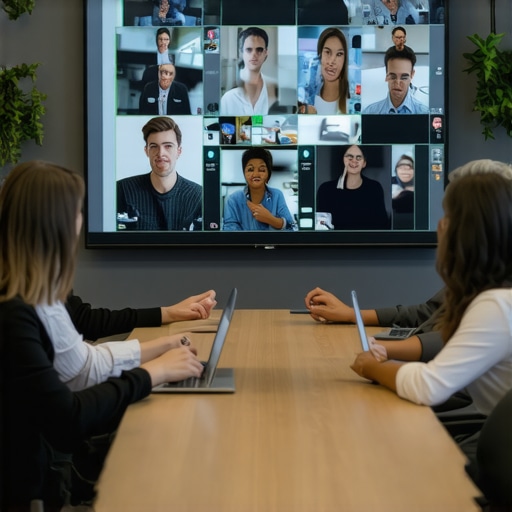
I sat there in my home office, holding a sad, lukewarm grocery-store cupcake while staring at sixteen tiny boxes on a screen. On the other end, the half of my team that lived near our local hub was laughing, sharing a real cake, and clinking glasses in a physical room. I was the CEO, and I felt like an outsider at my own company party. That was the ‘lightbulb moment’ when I realized our culture was a house of cards. I had fallen into the trap of thinking that a few Slack channels and a shared Google Drive counted as ‘belonging.’ It didn’t. This painful disconnect is the real reason your team is suffering from Zoom fatigue today. We’re going to fix that. Today, I’m sharing how we stopped the ‘us vs. them’ mentality and started building a culture that actually sticks, regardless of whether your desk is in a bedroom or a bustling startup hub.
The Day I Realized My Team Was Splitting in Two
One of the biggest mistakes I made early on was assuming that if the work got done, the culture would take care of itself. I prioritized ‘output’ over ‘connection,’ and it nearly cost me my best developers. When you have a hybrid setup, the people in the office get the inside jokes, the hallway brainstorming, and the spontaneous lunches, while the remote folks just get the calendar invites. This ‘proximity bias’ is a silent killer for morale. I’ve learned the hard way that the logistics of scaling a hybrid team without a corporate hq require more than just good software; they require intentionality. We had to stop treating our remote workers like satellite observers and start treating them like core participants. According to a study by Gallup, employees who feel connected to their culture are 3.7 times more likely to be engaged, yet hybrid teams often see that connection wither within six months. Have you ever felt that awkward silence on a call when the ‘office’ group is laughing at a joke you didn’t hear? If so, you’re already in the danger zone.
Is a strong culture actually possible without a shared headquarters?
It’s the question that keeps founders up at night. The short answer is yes, but it won’t happen by accident. You can’t just tell people to ‘be more social’ over a screen. We found that the key was moving away from the home office isolation and creating ‘anchor points’ for collaboration. I started encouraging my remote folks to use local spaces to get out of their shells, because I realized that how to stop your team from burning out in a home office often starts with a change of scenery. We also realized that why physical collaboration still beats video calls for startups is a reality we couldn’t ignore, so we shifted our focus to making the times we *do* meet in person count for double. We stopped using our rare face-to-face time for status updates and started using it for the messy, creative work that builds trust. It was a total game-changer for our retention rates.
Make Digital the Default Even in Person
To bridge the gap, you have to treat your physical office like it is just another remote node. When I finally figured out how to build a company culture when half the team is remote, the first rule was: if it did not happen in a shared digital space, it did not happen. We stopped making decisions over the coffee machine. If a brilliant idea struck during a lunch break at the hub, we would immediately post it to the relevant channel. This is about radical transparency. We also moved away from constant live check-ins. Honestly, why we stopped using Zoom for internal feedback loops was a sanity-saver. We started using recorded screen-shares instead. It gave our remote developers in different time zones the chance to digest the information without being woken up by a quick sync notification at 2:00 AM.
Stop Squashing Big Ideas in Tiny Rooms
The physical space you choose for your hybrid meetups acts as the container for your team energy. I remember booking a windowless flex office for a quarterly planning session that felt more like a bunker. By noon, everyone was irritable. That was the day I realized how to pick a meeting room that doesn’t smell like old carpet is a vital leadership skill. You need air, light, and space to breathe. #IMAGE_PLACE_HOLDER_B# There is a biological reason why your team is more creative in a room with high ceilings—it literally lowers cortisol and encourages abstract thinking. Now, when we bring the whole team together, we prioritize the environment. We look for the difference between a standard meeting room and a real war room to ensure the physical setting matches the intensity of the work we are doing.
Equip the Hub to Serve the Remote
Your physical hub should not just be a place for the local crew to hang out; it should be a high-end broadcast studio for the remote crew. Early on, I ignored our office lighting and acoustics. I would be sitting in a bright sun-glare, looking like a silhouette on camera, wondering why my remote team seemed disengaged. You have to stop letting bad lighting ruin your video calls if you want to be taken seriously. I have seen firsthand why your pitch fails in a noisy lobby when trying to coordinate a hybrid client call. It feels amateur. We eventually invested in the acoustics hack for crystal clear client pitches, installing sound-dampening panels and high-quality directional mics. This was not just about gear; it was a signal to our remote staff that their ability to hear and be heard was our top priority.
Move High-Stakes Moments to Neutral Ground
When the office team is on their home turf, they naturally dominate the space. To break this, we started hosting our most important reviews in neutral coworking spaces. I found that the best ways to use a day pass for maximum output impact often involve getting everyone out of their routine. When everyone—even the CEO—is in a new environment, it levels the playing field. We would book a professional suite and suddenly, the us vs. them dynamic vanished because we were all guests in the space together. This shift in the power dynamic is why physical collaboration still beats video calls for startups during those critical growth phases where everyone needs to feel like an equal stakeholder.Most founders fall into the ‘any space is a good space’ trap. They look at the square footage and the price tag, and they call it a day. But I’ve learned that the environment is a silent participant in every meeting. I used to think hot desking was the ultimate efficiency move for a growing team. In reality, I discovered that the truth about hot desking is it actually a productivity killer if you do not provide ‘zones’ for different types of work. It is not just about saving money; it is about protecting your team’s cognitive load. If your developers are constantly interrupted by sales calls because you are trying to save on a private suite, you are paying for that ‘savings’ with your burn rate. Sometimes, the move to a dedicated desk is the extra cost worth it just to anchor your team’s focus.
The Myth of the One Size Fits All Meeting Room
One of the biggest ‘oops’ factors I have witnessed is what I call the ‘Oversized Boardroom Syndrome.’ We once booked a massive, 20-person room for a critical four-person strategy session. The energy just evaporated into the empty corners of the room. It felt like we were giving a lecture rather than brainstorming. To keep the intensity high, you have to apply the two-pizza rule for booking the right size meeting room. If the room is too big, the conversation feels formal and stiff; if it is too small, people feel claustrophobic and rushed. Finding the middle ground is part of those startup success secrets choosing the perfect conference room at 0817 am that no one tells you about when you are first starting out. #IMAGE_PLACE_HOLDER_C#
Can you really protect your startup’s secrets in an open plan lounge?
This is a major concern for advanced founders. It is one thing to be social; it is another to leak your product roadmap to the competitor sitting at the next table. Learning how to keep your startups trade secrets safe in a public lounge is about more than just privacy screens; it is about spatial awareness. A study published by Steelcase found that 85% of workers are unsatisfied with their ability to concentrate and find privacy in their office environments. If you are handling a sensitive seed round or a VIP demo, you should not be sitting in the open café. That is when you need to level up and understand how to host a vip demo without a corporate headquarters by utilizing professional, sound-proofed suites.
Networking Happens at the Printer Not the Mixer
Here is a contrarian view: most ‘networking mixers’ are a waste of time. They are awkward, forced, and rarely lead to deep partnerships. In my experience, why small talk at the printer is the most valuable part of your day is the real secret to growth. It is the unscripted, organic collisions that lead to the best hires. We actually found why communal kitchens are the best place to find your next cto because people are more honest over a coffee machine than they are behind a LinkedIn DM. If you are planning a massive event, you need to master the logistics of hosting a 50 person hackathon in a coworking space to ensure those collisions actually happen. Have you ever fallen into the trap of thinking a bigger office would solve your culture problems? Let me know in the comments.Maintaining a hybrid culture is like maintaining a garden—you can’t just water it once and walk away. After years of trial and error, I’ve realized that the ‘invisible’ infrastructure is what actually keeps the lights on. I remember a particularly disastrous meeting where we lost twenty minutes just trying to find a dongle. That was the day I realized why your conference room needs better technology and fewer cables. We swapped our messy wires for a dedicated wireless casting system, and suddenly, the flow of our ideas wasn’t being interrupted by hardware tantrums. If you’re constantly fighting with your tech, you aren’t doing deep work; you’re acting as unpaid IT support for a room you’re renting. #IMAGE_PLACE_HOLDER_D#
How do I keep the momentum going as the team gets bigger?
It is easy to feel connected when you are just three people in a garage, but everything changes during the move that helped us scale from 3 to 15 people in six months. At that size, you can no longer rely on ‘vibes’ to keep everyone aligned. We started performing the 10-minute audit to see if your office space is wasting money every single quarter. If a specific room or desk wasn’t facilitating those ‘organic collisions’ we talked about, we cut it. This ruthlessness with our environment is why flex space is the ultimate hedge against market volatility; it allowed us to expand and contract our footprint without the anchor of a long-term lease dragging us down.
The Tech Stack of a Post-HQ World
For audio, I stopped relying on laptop mics. We invested in beamforming microphones that track whoever is speaking in the room. A technical whitepaper from the Fraunhofer Institute on spatial audio suggests that listener fatigue drops significantly when the human brain can spatially locate where a voice is coming from, even through a speaker. This makes our remote team members feel like they are actually ‘in’ the room rather than just listening to a flat broadcast. Looking forward, I believe the future of conference rooms in startup ecosystems will involve even more immersive AR overlays, where remote participants appear as avatars at the physical table. It sounds sci-fi, but we’re already halfway there with 360-degree cameras. My challenge to you: audit your current setup today. Pick one piece of friction—a bad mic, a flickering screen, or a cramped desk—and fix it. Your team’s focus is too valuable to waste on bad hardware.
The Hardest Lesson I Learned About Scaling Beyond the Coffee Shop
Reflecting on our growth, I realized that company culture isn’t a fixed state—it’s a living organism that changes shape every time you hire a new person. When we navigated the move that helped us scale from 3 to 15 people in six months, I learned that ‘the office’ is no longer a destination; it’s a tool. If your tools are rusty, your work will suffer. Here are three lightbulb moments from my journey:
- The ‘Vibe’ Myth: You cannot rely on a cool logo and a ping-pong table to build loyalty. Real connection happens during networking opportunities in top coworking environments where your team interacts with the wider world.
- Financial Agility: Long-term leases are the enemy of innovation. I’ve seen first-hand why flex space is the ultimate hedge against market volatility, allowing us to pivot when the world changed.
- Invisible Inequity: If you don’t intentionally design for the person on the screen, they will eventually leave.
The Toolkit That Keeps Our Hybrid Engine Humming
To keep the momentum, I rely on a specific set of resources that go beyond simple video calls. I recommend looking into these three essentials:
- Loom: This was our secret weapon for asynchronous work. It’s the primary reason why we stopped using Zoom for internal feedback loops, saving everyone from meeting fatigue.
- Deep Work by Cal Newport: This book changed how I view office design, leading me to conduct the 10-minute audit to see if your office space is wasting money on distracting layouts.
- Wireless Casting Systems: Never underestimate the power of a cable-free room. Check out why your conference room needs better technology and fewer cables to avoid the ‘dongle death’ that kills creative flow.
#IMAGE_PLACE_HOLDER_E#
Build the Culture Your Future Team Deserves
Transitioning into a hybrid world isn’t just about changing your Wi-Fi password; it’s about changing your perspective. You have the chance to redefine what work looks like for the next generation of talent. By mastering how to build a company culture when half the team is remote, you aren’t just surviving—you’re leading. Don’t be afraid to experiment with your physical space, try new coworking hubs, and listen to your team’s feedback. The future belongs to the flexible. What is the one thing about your current workspace that drives your team crazy? Let me know in the comments below!