

I’ll never forget the day I lost a $50,000 seed check because of a cinnamon roll. Okay, it wasn’t the pastry itself, but the environment where it was served. I was huddled in a corner booth of a local café, shouting over a steam wand to explain our burn rate to a very confused investor. My deck was flawless, but my surroundings were a train wreck. That’s the hard truth most founders ignore: your slides don’t matter if the person across from you can’t hear your heart beating. It was humiliating.
The Atmosphere is Your Unspoken Business Partner
It’s a mistake I made early on, thinking that “scrappy” meant “anywhere with Wi-Fi.” I thought I was saving money, but I was actually burning bridges before the first slide even loaded. When you bring a high-stakes conversation into a noisy public space, you aren’t just battling the decibel level; you’re signaling that your time—and theirs—isn’t worth a quiet door. Investors look for stability. A study from the University of California, Irvine, highlights that it takes over 23 minutes to regain deep focus after a single interruption. If a barista shouts a drink order in the middle of your revenue projections, you’ve lost that investor’s focus for the rest of the hour. We need to move past the “coffee shop phase.” I have learned the hard way that passing a basic acoustics test is actually more important than your font choice or your fancy transition animations.
Does the Location Really Change the Outcome?
You might think a great product speaks for itself, regardless of the room. I used to believe that too. But I quickly learned that investors prefer professional settings not because they’re snobs, but because they value clarity and confidentiality. If you are currently struggling to manage noise in a shared space, it is time to rethink your strategy before your next big meeting. Have you ever had a brilliant point completely ruined by someone else’s loud phone call? It’s time we talk about how to stop your environment from sabotaging your growth and how to pick a space that actually supports your ambition.
How to Stop Settling for Second-Rate Spaces
The transition from a laptop in a café to a professional environment starts with a mental shift. You aren’t just renting a desk; you are buying infrastructure that supports your focus. I remember trying to close a $20k contract while my laptop battery was at 4% and the only available outlet was hidden behind a trash can. It was a mess. Now, I treat the selection process like hiring a CTO—meticulous and data-driven. When you choose the perfect conference room, you’re looking for more than four walls; you’re looking for a performance enhancer that removes every possible friction point between you and a ‘yes’.
Check the Tech Before You Invite the Board
Your laptop screen is a small window, but a dedicated presentation monitor is a billboard for your vision. I’ve seen founders squinting at 13-inch displays during a pitch, and let me tell you, it kills the energy. This is exactly why your pitch deck looks better on a forty-inch screen than a flickering MacBook. It’s the difference between showing a movie on a phone versus an IMAX theater. You need reliable high-speed fiber, integrated audio that doesn’t crackle, and fewer cables cluttering the table. 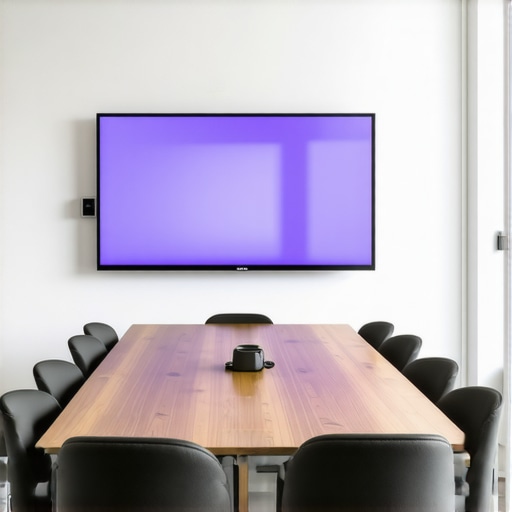
Keep Your Secrets Behind a Closed Door
One Tuesday, I was discussing a confidential pivot in a shared lounge, only to realize a freelancer for a direct competitor was sitting three feet away with his headphones off. My heart stopped. Since then, I’ve been obsessed with physical security. Whether you are conducting a performance review or discussing equity, you must know how to handle a sensitive HR meeting or strategic shift away from prying ears. Learning how to keep your startup’s trade secrets means admitting that a booth at a diner isn’t enough—you need soundproofed isolation where the only people hearing your strategy are the ones on your cap table.
Pick a Membership Level That Actually Grows With You
Don’t get locked into a five-year lease when your team is doubling every six months. I’ve seen companies suffocate in expensive, static offices that they outgrew in ninety days. Instead, focus on agility. Many founders eventually realize why membership flexibility is more important than square footage during those early, unpredictable growth spurts. You need a space that helps you maximize productivity in your startup’s conference rooms without forcing you to pay for empty desks. Think of it like cloud computing for physical space: pay for what you use today, and scale up the moment the next round of funding hits your bank account. Real growth requires a modern flex-space strategy that adapts to your headcount, not the other way around.
Identify the Purpose Before You Book
Not all rooms are created equal. A brainstorming session needs whiteboards and standing room, while a board meeting needs a heavy table and a sense of authority. I once booked a ‘creative pod’ for a legal review and we spent two hours sitting on beanbags trying to sign documents. It was ridiculous. You have to understand why your meeting room needs to be more than just a table. It needs to match the gravity of the conversation. If you are aiming for a high-stakes deal, vetting a high-stakes board room with the right lighting and acoustics is the only way to ensure your environment doesn’t betray your professionalism.
There is a pervasive myth in the tech world that a ‘digital-first’ culture means you never need to see your team’s faces in three dimensions. I used to shout this from the rooftops—until our first major product bug almost sank us. We spent three days on Slack and Zoom trying to diagnose the issue, getting nowhere while frustration boiled over. Then, we rented a dedicated space for 48 hours. The breakthrough happened in twenty minutes because we could finally point at the same whiteboard and read each other’s micro-expressions. This is why I argue that physical collaboration still beats video calls for startups when the stakes are high. You need a space that functions as a command center, not just a place to sit.
Stop Mistaking Zoom for Real Synergy
The contrarian truth is that digital tools are for maintenance, but physical rooms are for breakthroughs. When you are building something from zero, the latency of a video call—even just a few milliseconds—acts as a tax on creativity. A study published in Nature in 2022 found that video conferencing actually inhibits the production of creative ideas compared to in-person meetings because the screen narrows our visual and cognitive focus. To innovate, you need the peripheral vision and spontaneous interruptions that only happen in a shared environment. This is the difference between a standard meeting room and a real war room; one is for reporting status updates, the other is for solving the unsolvable.
Does Your Remote Policy Actually Slow Down Innovation?
I’ve spoken to dozens of founders who wonder why their product cycles are stretching from weeks to months. Often, the culprit is the lack of a ‘physical anchor.’ Without a home base, your company culture becomes a series of disjointed calendar invites. By utilizing innovative meeting rooms that boost startup creativity, you provide your team with a high-bandwidth environment that no fiber-optic cable can replicate. Whether you are figuring out how to transition your team from a garage to a real office or just need a weekly touchpoint, why your startup needs a physical anchor becomes clear the moment you see the jump in velocity after an in-person sprint. 
Avoid the Fishbowl: The Hidden Cost of Glass Offices
Here is the ‘oops’ factor I see constantly: founders booking ‘prestige’ rooms that are essentially glass boxes. They look incredible in photos, but they are an acoustic and psychological nightmare. In a glass-walled room, your team is constantly distracted by outside movement, and worse, they feel ‘on display,’ which kills honest, messy debate. Furthermore, if you don’t check for the acoustic fix for echoey conference rooms, the reverb will make your recorded demos sound amateur. When searching for startup success secrets in choosing the perfect conference room, prioritize sound treatment and visual privacy over ‘the view.’ Your board won’t care about the skyline if they can’t hear your revenue projections over the echo of their own voices. Have you ever fallen into this trap? Let me know in the comments.
Kill the Dongle Chaos Forever
Maintenance isn’t just about keeping the floors clean; it’s about ensuring the friction of the ‘physical’ world doesn’t slow down your digital output. I used to spend the first fifteen minutes of every high-stakes board meeting wrestling with HDMI adapters and broken Wi-Fi passwords. It was amateur hour. Now, I strictly audit every space for a ‘one-cable’ solution. This is exactly why our private office suites stock extra surface pro chargers for members—because nothing kills a closing argument like a 0% battery notification. Crestron’s 2024 ‘Modern Work’ report found that 67% of users feel significant frustration due to ‘meeting room start-up lag,’ which can cost a team hundreds of hours in lost productivity annually. To avoid this, I always keep the checklist for a glitch-free product launch event handy, ensuring that every piece of tech, from the wireless mics to the backup hotspots, is tested forty-eight hours before the doors open.
How do I maintain my workspace quality without a dedicated office manager?
If you are a founder, you are the de facto facilities manager until you hit Series B. The secret is to treat your environment as a product. Every quarter, I run a ‘usage audit’ to see how to save money on office amenities your team doesn’t use. If the fancy espresso machine is gathering dust but the standing desks are always booked, pivot your budget. Maintaining quality means being ruthless about functionality. I recommend using a simple booking app that tracks room ‘health’—if a team reports a fuzzy monitor twice, that room is taken offline immediately. 
Audit Your Space Before You Burn Your Budget
Scaling too fast is the leading cause of startup death, and that includes your overhead. I’ve seen teams lock themselves into massive leases, only to realize half their staff prefers working from a quiet zone on Tuesdays. You need to know how to pick a membership tier that scales with your team rather than guessing your headcount for 2027. We use a ‘burst’ strategy: we keep a small private office for core operations and use credits to book innovative meeting rooms that boost startup creativity only when the whole team is in town. This prevents us from paying for empty square footage while ensuring we never lack the space for a breakthrough sprint.
The Future is Smarter Than a Four-Wall Lease
I predict that the future of conference rooms in startup ecosystems will move toward biometric environmental tuning. Imagine a room that recognizes your team’s arrival and automatically adjusts the lighting temperature to stimulate focus and sets the desk heights to your saved preferences. We are moving away from ‘renting a desk’ and toward ‘purchasing a high-performance state of mind.’ Don’t wait for the future to catch up; start treating your physical presence as a strategic asset today. My challenge to you: audit your current workspace this week. If it doesn’t provide at least three tech tools that make your life easier, it’s time to move.
The Brutal Truth About the ‘Garage Phase’ I Never Saw Coming
Looking back, the biggest lesson wasn’t about the product; it was about the signal. I realized that scrappiness is a mindset, not a location. You can be a lean, agile startup while still operating from a space that commands respect. I also learned that the energy of other founders is contagious—working in a vacuum is the fastest way to burn out. Finally, I discovered that silence isn’t just a lack of noise; it’s the space where your best ideas actually have room to breathe, especially when you know how to find a quiet meeting room on short notice during a crisis.
My Personal High-Performance Meeting Toolkit
I don’t leave things to chance anymore. For scheduling, I rely on automated tools so I never have to manually figure out how to book a meeting room in under sixty seconds when a client calls. I also keep a “Meeting Go-Bag” with high-quality adapters and a portable light ring for those video calls where lighting matters. Most importantly, I vet my locations by learning how to find a coworking space that matches your company values, because if the vibe is off, the work will be too. #IMAGE_PLACEHOLDER_E#
Building More Than Just a Product
You’ve put in the hours, the sweat, and the late-night code sessions. Don’t let a sub-par environment be the thing that holds your vision back. Whether you’re looking into top meeting rooms of 2025 or simply searching for networking opportunities in top coworking environments, remember that you deserve a space that works as hard as you do. Step out of the coffee shop and into your next big breakthrough. What’s the one ‘environmental’ mistake you’ve made that taught you the most about professionalism? Let me know in the comments below!