

The smell of cold pepperoni and the sound of my co-founder chewing two inches from my ear was the breaking point. It was 2023. We were three guys in a cramped apartment. We were trying to build a global platform on mismatched kitchen chairs. I realized we couldn’t hire person number four. There literally wasn’t a square inch of table space left. If we wanted to grow, we had to leave the ‘free’ home office behind. Making the jump to a professional workspace wasn’t just an expense. It was the fuel that took us to a team of 15 in six months. Today, I’m going to show you why that physical shift matters more than any software tool you’ll ever buy. It’s about more than just a desk.[IMAGE_PLACEHOLDER]
Stop trying to run a company from your couch
For the first few months, I was convinced that staying remote was the lean startup way. I was wrong. I made a massive mistake: I prioritized saving $800 a month over the speed of our communication and the sanity of our hires. When you are a trio, you can manage. When you try to hit five, six, or seven, the ‘where do we meet?’ question becomes a daily tax on your brain that drains your energy. I finally sat down and looked at the checklist for moving your startup into its first real office and realized we were already months behind. We weren’t just missing desks; we were missing the ‘war room’ energy that only happens when you’re in the same room. We eventually made the move from a garage to a flex office, and the shift in morale was instant. Suddenly, we had a professional anchor. Have you ever felt like your team’s growth is physically capped by your current four walls?
Is a professional room really worth the cash right now?
I get the skepticism. Rent is scary when your revenue is still a jagged line on a spreadsheet. But consider the cost of a bad first impression. We lost a potential lead because I tried to host a meeting in a noisy coffee shop where the Wi-Fi dropped twice. It was embarrassing. Interestingly, research published by the Harvard Business Review found that people who use coworking spaces report significantly higher levels of thriving—nearly 6 on a 7-point scale—because these spaces provide both social connection and a clear professional identity. When we moved, we didn’t just get a desk; we got access to innovative meeting rooms that boost startup creativity and, more importantly, a place where our new hires felt they belonged to a real company. We learned how to transition your team from a garage to a real office the hard way, but the results speak for themselves. Physical proximity matters more than I wanted to admit, and why physical collaboration still beats video calls for startups became clear the moment we all stood around a whiteboard for the first time without a screen between us.
Don’t sign that lease until you’ve spent a Tuesday there
The biggest mistake I see founders make is falling in love with a lobby. A lobby is a facade. You need to know what the space feels like at 2:00 PM on a Tuesday when everyone is on a Zoom call and the printer is jammed. My advice is simple: learn how to use a day pass to test your next potential office before committing even a single month of runway. I remember when we almost signed for a beautiful spot in the arts district. It had exposed brick and great coffee, but ten minutes into our trial, I realized the Wi-Fi couldn’t handle three simultaneous video calls. We avoided the hidden drag of slow office wi-fi on your burn rate simply by testing it first. If the internet fails you during a high-stakes pitch, no amount of free kombucha will save your reputation.
How to pick a war room that actually closes deals
When you transition from a couch to a suite, your meetings change. You aren’t just ‘syncing’ anymore; you are performing for clients and investors. You need to know how to find a conference room that actually has working adapters and reliable tech. Nothing kills a vibe faster than spending fifteen minutes looking for a dongle while an investor watches you sweat. We once hosted a potential partner in a room that looked great but had the acoustics of a tin can. Every word echoed, and we spent the whole time repeating ourselves. Now, I always check the acoustics test every conference room should pass before I book a space for high-stakes conversations. #IMAGE_PLACE_HOLDER_B# Your workspace should act as a force multiplier, which is why learning how to maximize productivity in your startups conference rooms is a skill you need to master early.
Know exactly when to ditch the hot desks
Hot-desking is great for freelancers, but it can be a silent killer for a growing team. When you are scaling from 2 to 20, you need a home base. We stayed in an open-plan hot-desking setup for two months too long. My lead dev spent half his morning just finding a spot near a power outlet, and our designer was constantly distracted by the ‘loud talker’ three tables over. We eventually moved to a dedicated suite and realized the move to a dedicated desk is the extra cost worth it because it eliminated the daily friction of relocation. If you find yourself spending more time managing your environment than your product, you’ve stayed at the ‘free’ level too long. Professionalism isn’t about vanity; it’s about removing the obstacles that prevent your team from doing their best work. Look for top meeting rooms of 2025 that offer flexible growth options so you aren’t stuck in a box that you’ll outgrow in three months.
The mistake most founders make—and I was guilty of this too—is focusing on the ‘cool factor’ rather than the ‘output factor.’ We are often told that a startup needs a pool table, a craft beer tap, and neon signs to attract talent. In reality, these are often just distractions that mask a poorly designed workspace. I’ve seen teams spend thousands on aesthetics while ignoring the fact that their meeting rooms have the privacy of a glass bowl. If you are chasing a vibe instead of functionality, you are falling for what I call ‘amenity-washing.’ It is vital to learn the truth about free perks you never actually use before you sign away your seed money on a space that looks like a playground but works like a zoo.

Stop chasing ‘vibes’ and start measuring output
Everyone says a vibrant open-plan office is the key to serendipitous innovation. My experience? It’s usually the key to constant interruption. While the social aspect of coworking is great for networking, it can be a nightmare for deep work. A study by researchers at the University of Sydney found that lack of sound privacy is consistently the number one complaint in modern office environments, far outweighing concerns about cleanliness or light. When we moved, I stopped looking at the brand of coffee and started looking at the decibel levels. We learned how to save money on office amenities your team doesn’t use by prioritizing soundproof booths over lounge beanbags. High-growth teams don’t need a DJ in the lobby; they need a quiet place to think.
How much acoustic privacy do you actually need?
If you are handling sensitive client data or pitching VCs, the answer is ‘total.’ One of the biggest ‘oops’ factors I’ve witnessed is a founder pitching a sensitive deal in a ‘private’ room, only to realize the person in the next suite could hear every word. You must know how to vet a meeting room for acoustic privacy before booking it for anything high-stakes. Don’t just trust the sales rep; stand inside, have a teammate talk loudly outside, and check the seal on the door. It sounds paranoid until you realize your trade secrets are leaking through the drywall. Implementing the acoustics hack for crystal-clear client pitches early on saved us from several embarrassing technical glitches during our Series A roadshow.
Your tech stack is more important than your street address
We once prioritized a prestigious downtown address over a building with fiber-optic internet. It was a disaster. A prestigious zip code won’t save a product demo that buffers every thirty seconds. This is where startup success secrets choosing the perfect conference room come into play: prioritize the ‘invisible’ infrastructure. I now look for why your conference room needs better technology and fewer cables because nothing signals ‘amateur’ like a CEO struggling with a HDMI dongle for ten minutes. Even small details, like the surprising impact of office plants on team morale and output, can be more effective for productivity than a flashy lobby. Have you ever fallen into this trap of choosing style over substance? Let me know in the comments.
The hardware I actually swear by for long-distance pitches
Once you have the walls, you need the guts. I wasted thousands on ‘all-in-one’ gadgets that promised the world but delivered grainy video. Today, our ‘war room’ is built around the Logitech Rally system. Why? Because the auto-framing feature means I don’t have to play cameraman while I’m trying to close a seed round. I’ve found that why your conference room needs better technology and fewer cables is the difference between a smooth demo and a technical nightmare. We also standardized our adapters. We use a dedicated ‘tech tub’—a simple plastic bin—to ensure we know how to find a conference room that actually has working adapters every single time. It is a low-tech solution for a high-tech problem. 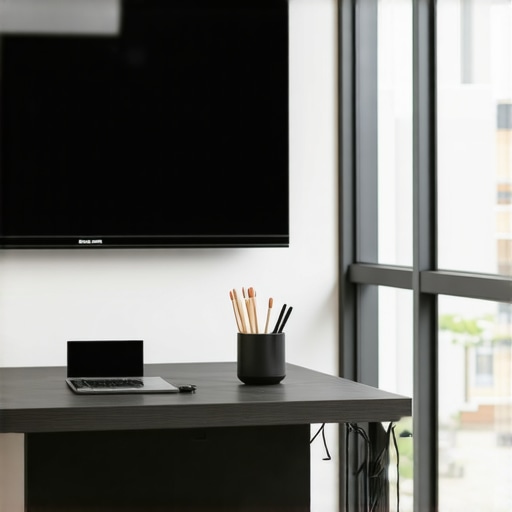
How do I keep our shared spaces from becoming a mess as we grow?
Maintenance is where most startups fail. You move in, it looks great for a week, and then the communal kitchen becomes a biohazard. I implemented a ‘clear desk’ policy that we actually enforce. If you are scaling from 2 to 20, you need a system like Skedda or Robin to manage room bookings. I’ve seen teams lose hours of productivity because two people thought they had the ‘quiet room’ booked at the same time. This is part of the logistics of scaling a hybrid team without a corporate hq—you need digital guardrails. According to Gartner’s Digital Workplace research, by 2025, 50% of meetings will be augmented by AI-driven spatial intelligence to manage room occupancy and environmental settings automatically. We are already moving toward that. I predict the ‘office of the future’ won’t just be a place you go, but a smart environment that knows you need a 22-degree room with whiteboards ready before you even walk in.
The logistics of scaling without a 10-year lease
The beauty of the current market is that you don’t have to be locked down. We treat our office like a software subscription. If we need more space, we upgrade the tier. If we need a specialized spot for a launch, we look at transforming meeting rooms into collaboration hubs for a weekend. It’s about flexibility. This shift is why the future of conference rooms in startup ecosystems is leaning toward modular, on-demand spaces rather than static boardrooms. My biggest tip for you right now? Conduct a ‘tech audit’ this Friday. Walk into your primary meeting space and try to launch a video call in under 60 seconds. If you cannot do it without hunting for a cable or a remote, you are losing money every single day. Fix the friction now before your next big pitch depends on it.
The Brutal Truth About Scaling Beyond Your First Three Hires
Looking back, I realize that our ‘lean’ phase was actually a stagnation phase in disguise. Here is the reality of the jump: first, your brand is only as strong as the environment where you host your guests. I spent months thinking a coffee shop was ‘scrappy,’ but ditching the basement changed how my team saw themselves and how investors saw us. Second, culture isn’t a set of values on a PDF; it is the spontaneous laughter in the breakroom. Third, I learned that the logistics of moving your startup to a professional space are manageable if you prioritize flexibility over a five-year commitment. The biggest ‘aha’ moment? Realizing that a door you can close for a private strategy session is worth ten ‘open-concept’ beanbag areas.
The Small Toolkit That Saved Our High-Stakes Meetings
If you are ready to stop winging it, I recommend focusing on three core areas. For logistics, go through the checklist for moving your startup into its first real office before you even look at a floor plan. For technology, ditch the cheap HDMI cables and invest in a dedicated hub; it will pay for itself in saved stress during pitches. Finally, when it comes to the room itself, learn how to choose the perfect conference room for business success by focusing on lighting and internet stability over the view. These are the boring details that actually build unicorns.
Give Your Startup the Room It Needs to Breathe
Moving out of the comfort of your home is a terrifying financial milestone, but it is the physical manifestation of your belief in your company. You aren’t just buying a desk; you are buying the right to focus, the power of proximity, and the professional edge that your product deserves. Your team is waiting for a place they can call a ‘war room.’ Go find it and let your meeting rooms become the birthplace of your biggest breakthroughs. Have you ever felt like you were outgrowing your current setup but were too afraid to take the financial leap? Let me know your experience in the comments below.